To pagans, the predawn worship of Christians and their acts of faith were a mystery, which was made no more understandable by the martyred bishop of Lyons, who, when asked who was the Christian god, replied only that "If you are a fit person, you shall know." Attalus, too, said only that the name of his god was not like that of a man. Such secrecy elicited lurid notions of immorality, and there were accusations of "Thyestean banquets [cannibalism] and Oedipean incest, and things we ought never to speak or think about, or even believe that such things ever happened among human beings" (Eusebius, Ecclesiastical History, V.1.14).
Marcus Cornelius Fronto, an orator and rhetorician who was the tutor of Marcus Aurelius and later his correspondent, condemned the Christians in a lost speech, fragments of which are preserved by Minucius Felix in the Octavius, a dialogue between the pagan Caecilius and the Christian Octavius that sought to refute such charges. One was that "They are initiated by the slaughter and the blood of an infant, and in shameless darkness they are all mixed up in an uncertain medley" (IX), another that "the charge of our entertainments being polluted with incest" (XXXI). Justin, who was martyred during the reign of Marcus Aurelius (the record of the trial, based on an official court report, still survives), also mentions "those fabulous and shameful deeds—the upsetting of the lamp, and promiscuous intercourse, and eating human flesh" (First Apology, I.26), calumnies that inspired fear and hostility.
Fronto asserted that "the religion of the Christians is foolish, inasmuch as they worship a crucified man, and even the instrument itself of his punishment. They are said to worship the head of an ass, and even the nature of their father" (IX). And Tacitus recounts how the Jews, expelled from Egypt, wandered in the desert, exhausted and dying of thirst, when, following a herd of wild asses, they were led to water. So, in the temple at Jerusalem, "they consecrated an image of the animal which had delivered them" (The Histories, V.3). Even though Pompey, upon entering the temple, found its sanctuary to be empty (V.9), it must have been from this story, supposes Tertullian, that the notion derived that Christians were "devoted to the worship of the same image" and that "our god is an ass's head" (Apology, XVI). Josephus, too, is obliged to refute the same charge in Against Apion (II.8ff).
Tertullian refers again to this notion that "our god is actually the head of an ass" in To the Nations, where he accuses pagans of being no better. "You in fact worship the ass in its entirety, not just the head. And then you throw in Epona, the patron saint of donkeys and all the beasts of burden, cattle, and wild animals. You even worship their stables. Perhaps this is your charge against us that in the midst of all these indiscriminate animal lovers, we save our devotion for asses alone" (XI)! He also defends Christians against the charge of a Roman Jew who "would carry around a picture directed against us with the heading 'Onocoetes,' meaning Donkey Priest. It was a picture of a man wearing a toga and the ears of the donkey with a book in hand and one leg ending in a hoof" (XIV).
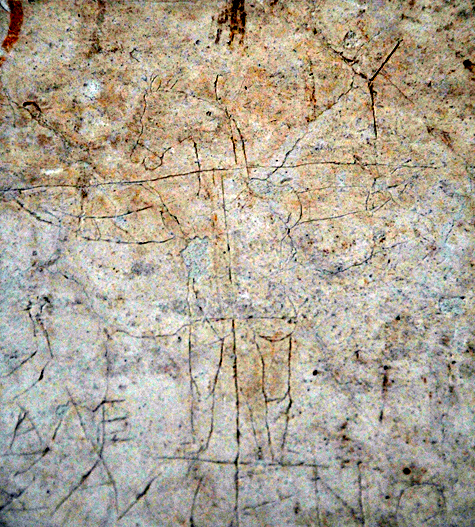
The earliest representation of the Crucifixion is the Alexamenos graffito, scratched on plaster about AD 200 and found in 1856 in the Paedagogium on the Palatine Hill, possibly a school to train servants in the imperial household. One sees from the caricature that the cross is low to the ground and in the shape of a T (a tau cross or crux commissa, after the Greek letter, rather than the Latin cross, crux immissa, that traditionally is depicted). Indeed, Tertullian remarks "Now the Greek letter tau and our own letter T is the very form of the cross, which He predicted would be the sign on our foreheads in the true Catholic Jerusalem" (Against Marcion, V.22; cf. Ezekiel 9:4, "set a mark upon the foreheads of the men"). There is a bar to support the feet and the hands are tied to the cross beam, which would have prolonged the agony of crucifixion. The Greek inscription scratched in the stone reads "Alexamenos worships [his] God."
An ignominious and shameful death and, in the words of Paul, "unto the Jews a stumblingblock, and unto the Greeks foolishness" (I Corinthians 1:23), the Crucifixion was rarely depicted in Christian art before the sixth century AD.
There were different forms of execution on a cross. "I see before me crosses not all alike, but differently made by different peoples: some hang a man head downwards [as Peter was said to have died, Acts of Peter, XXXVII], some force a stick upwards through his groin, some stretch out his arms on a forked gibbet" (Seneca, To Marcia on Consolation, XX.3). This forked gibbet was the patibulum, in which the neck was placed between two pieces of wood which then were fastened together. Because it killed by strangulation, the gibbet was considered a lesser form of punishment than the cross, for it "immediately kills those who are hanged on it, but the cross torments those nailed to it for a long time" (Isidore of Seville, Etymologies, V.27.34).
The Alexamenos graffito is in the Palatine Museum (Rome). Clamped high on the wall in the corner of the gallery, it seemingly is a blank slab, the lines of the original image almost invisible. To be discernible at all, the photograph must be enhanced.
References: Eusebius: The History of the Church (1965) translated by G. A. Williamson; The Ante-Nicene Fathers: Translations of the Writings of the Fathers Down to A.D. 325 (1885-1896) translated and edited by the Rev. Alexander Roberts and James Donaldson; A Select Library of Nicene and Post-Nicene Fathers of the Christian Church, Series II (1890-1896) edited by by Philip Schaff and Henry Wace; Tacitus: The Histories (1975) translated by Kenneth Wellesley (Penguin Classics). The principle text is Graffiti del Palatino: Paedagogium (1966) edited by Heikki Solin and Marja Itkonen-Kaila (the Alexamenos graffito is no. 246).
