"He [Agricola] sent his fleet ahead to plunder at various points and thus spread uncertainty and terror, and, with an army marching light, which he had reinforced with the bravest of the Britons and those whose loyalty had been proved during a long peace, reached the Graupian Mountain, which he found occupied by the enemy. The Britons were, in fact, undaunted by the loss of the previous battle, and welcomed the choice between revenge and enslavement. They had realized at last that common action was needed to meet the common danger, and had sent round embassies and drawn up treaties to rally the full force of all their states."
Tacitus, Agricola (XXIX)
Agricola was governor of Britain from AD 77-83/84 and the father-in-law of Tacitus, who wrote his biography. To subdue the recalcitrant Caledonian tribes to the north, Agricola marched beyond the isthmus formed by the Firth of Clyde and the Firth of Forth into the highlands of Scotland, establishing a series of temporary camps along the way. Meanwhile, the fleet was sent ahead to raid the coast and provide supplies. Probably by the late summer or early fall of AD 83, in the seventh and final campaign season of his governorship, Agricola and Calgacus, leader of the Caledonii and a confederation of northern clans, confronted one another at a place named Mons Graupius.
Tacitus writes in Agricola (XXIX-XXXVIII) that more than thirty thousand Britons held the high ground, where the tribes had arrayed themselves in ranks on the slope of the mount and their chariots occupied the plain below. Roman auxiliary troops numbered eight thousand infantry and four or five thousand cavalry, all chosen from loyal tribes and led on foot by Agricola himself. Held in reserve at the ramparts of the camp were the Roman legions—victory, writes Tacitus, being more glorious if there was no cost in Roman blood.
After an exchange of missiles, the auxiliaries (Batavi and Tungri from the Continent) closed in hand-to-hand combat, their short thrusting swords proving more effective than the long unwieldy swords and small shields of the Britons. At the same time, the cavalry dispersed the British chariots and themselves engaged the enemy on the sloping ground, the fray made even more chaotic by terrified riderless horses and unmanned chariots. As the Britons moved down the hill, Agricola threw in the reserve cavalry, which broke through the line and attacked them from the rear. Routed, the natives fled into the nearby forest, the remainder saved by the coming nightfall. Ten thousand Britons died; on the Roman side, says Tacitus, three-hundred sixty fell (figures that may be rhetorical, invented, or estimated). By dawn, there was only the silence of desolation and the smoke of huts burning in the distance, set fire by the Britons themselves. As Calgacus had bitterly remarked of the Romans before the battle, "They make a desert and call it 'peace'" (XXX).
Twenty thousand men retreated that night and, in spite of Tacitus' statement that the island had been conquered, the highlands still were relatively free beyond the Clyde-Forth isthmus. The fleet was commanded to continue north around Britain, reconnoitering the coast, while the army retired south. Early the next year, Agricola was recalled to Rome by a resentful Domitian who, jealous of his success, would deny him any further imperial appointments. In AD 85, there were barbarian attacks from Dacia in the east, and Domitian eventually was obliged to withdraw what military presence had remained behind in northern Britain. The fort at Inchtuthil, part of a series of garrisons that closed off the highlands, was dismantled not long after it had been completed and, with it, any plans to conquer the land.
Tacitus' description is the only literary evidence for the Battle of Mons Graupius, the location of which is not certain. Wherever the site, the requisites are that there be a mount, with an expanse of open ground before it, and the presence of a nearby Roman camp—although, even when there is an encampment, it cannot always be certain that it was contemporary with Agricola, built by a successor, or even later still during the campaigns of Septimius Severus in AD 208-211. Since Calgacus sought the confrontation, it also is presumed to have been on a route likely followed by the Romans on their march and near enough the coast for Agricola to maintain contact with his fleet.
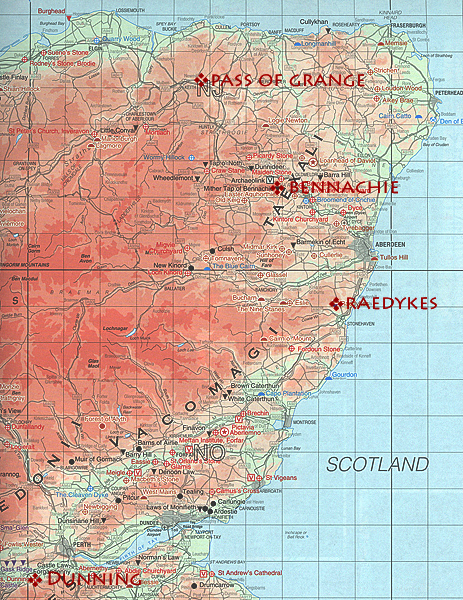
Several locations meet these requirements. One of the first to be put forward was Raedykes, a large camp situated where the Grampian foothills come closest to the sea and form a narrow corridor. Here, it has been argued, is a strategic site where the Romans would have to be confronted if they were not to advance farther north. But, although large enough to contain Agricola's men, Raedykes may be Severan in origin and seems too far south to be reconciled with Agricola's belief that he had reached the northern-most part of the island, indeed, that he was at "the furthest point of Britain" (XXXIII). The heights, too, are not prominent enough to give the impression of serried ranks on its slopes, as Tacitus recounted, nor is there necessarily sufficient moorland for the cavalry to maneuver.
The discovery of Durno, a marching camp near the mount at Bennachie, seems a more probable setting. The terrain satisfies Tacitus' description of the battle. There is room to have extended the Roman line and still allow for the movement of cavalry, and the slope opposite is steep enough to provide a defensive position and give the impression of tiered troops. The highlands to the west also offer a refuge for the defeated Caledonians. Still, there are objections, one of which is that Bennachie may be too broad a field for the combatants. The camp itself (which may not be contemporary) is the largest in northern Scotland, larger perhaps than necessary for what was, after all, an expeditionary force. And a river runs between the mount and the camp which, although providing a necessary source of water, is not mentioned in Tacitus' account of the battle. Finally, the site may be too far from the coast and the fleet.
More northerly still is the Pass of Grange, overlooked by Knock Hill, which does satisfy the remark of Calgacus that "there is no people beyond us, nothing but tides and rocks" (XXX). Here, the Grampian mountains again come close to the sea and there is an approach to the Moray Firth. It is an advantageous position, easy to defend and less than twenty kilometers from sheltered anchorage, where Agricola's fleet could have waited. But the Roman camp at Auchinhove and a larger one at Muiryfold both seem too small and too removed from the battle.
Given that the battle of Mons Graupius took place late in the military season and that the army quickly reached the site, a southern alternative has been proposed at Duncrub, a hill west of the Firth of Tay. The name likely derives from crup, meaning a hump, and is etymologically related to Craupius, which seems to have been the Latinized version of the original name. There also is a large contemporary Roman camp at Dunning. But Duncrub would seem too low for Tacitus to remark on the Britons being "packed together on the slopes of the hill, rising up as it were in tiers" (XXXV). And, for a battle said to have taken place in the north, Dunning is the most southern of the suggested Roman marching camps.
Most recently, Fraser has identified Gask Ridge as the site of the battle. But this escarpment, which is across the River Earn from Duncrub, has its own weaknesses, the most important of which is that the river meanders through the middle of the battle field and would not have allowed room for the chariots to maneuver. Too, the ridge itself rises so abruptly from the river bank that it may have been difficult for the Britons to advance.
Durno had been discovered not long before Salway completed his book on Roman Britain, which may account for the pronouncement that "it is very likely indeed that the mountain now known as Bennachie is rightly to be identified as Mons Graupius." In a later revision, however, he is more circumspect: "Pending new evidence, we can do no more than say that it was somewhere in north-east Scotland." And that may be the one thing that can be said with certainty about the Battle of Mons Graupius.
Some possible locations have been placed on a detail above from the Ordnance Survey Historical Map of Ancient Britain (2005), which includes the national and historical monuments from the neolithic to the early medieval periods. The only other map in the series is Historical Map of Roman Britain (2001).
References: Tacitus on Britain and Germany (1948) translated by H. Mattingly (Penguin Classics); Tacitus: Agricola and Germany (1999) translated by Anthony R. Birley (Oxford World's Classics); A Battle Lost: Romans & Caledonians at Mons Graupius (1990) by Gordon Maxwell; The Roman Conquest of Scotland: The Battle of Mons Graupius AD 84 (2005) by James E. Fraser; Roman Britain (1981) by Peter Salway; Agricola and the Conquest of the North (1987) by W. S. Hanson; The Fasti of Roman Britain (1981) by Anthony R. Birley.
A bibliographic note: Peter Salway is one of the most authoritative authors on Roman Britain, and the Oxford University Press has published a number of his books, some of which appear in more than one edition. In 1937, the first volume in The Oxford History of England series was published, and Roman Britain and the English Settlements by R. G. Collingwood and J. N. L. Myres has remained an important reference ever since. Originally, Salway was invited to revise it but instead wrote an entirely new book: Roman Britain, which was published in 1981 and reissued in paperback in 1984.
Oxford University Press also has a series of illustrated histories, one of which is The Oxford Illustrated History of Britain by Peter Salway and John Blair, which was published in 1984. Four years later, the first two chapters of that book were reprinted in paperback as Roman and Anglo Saxon Britain in The Oxford History of Britain series. In 1993, another handsome volume in this illustrated series appeared: Salway's The Oxford Illustrated History of Roman Britain. Four years later, it, too, was issued in paperback as A History of Roman Britain.
As which to read: In paperback, there are two choices: Roman Britain (1981/1984) and A History of Roman Britain (1993/1997). The first is two hundred pages longer and footnoted; the second is a condensed and revised version of the earlier book that takes into account later research and, in hardback, is beautifully illustrated.
