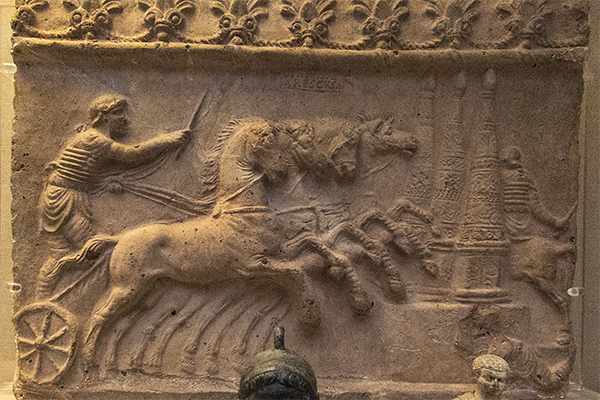
Although mentioned for the first time only in 174 BC, the three turning posts or metae (cones) at either end of the spina must have been one of the original features of the Circus. Situated on their own plinths, the three tapered pillars had an egg-shaped finial. They may have been inspired by the markers used by Roman surveyors or derive from Etruscan funerary monuments, an association that certainly would have been appropriate, given that the turning points were the most dangerous part of the race—as can be seen in the charioteer who has fallen and cowers in the turn.
In these terracotta reliefs, of which there are at least two variants and ten examples, a quadriga approaches the three cones of the metae. Riding ahead is the hortator or jubilator, who encouraged the charioteers.
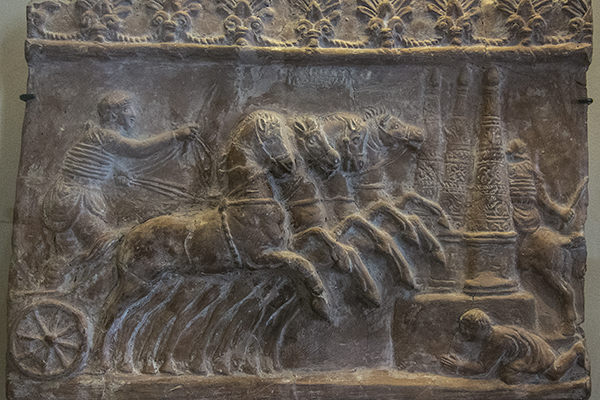
The first plaque, which dates to the last third of the first century AD, is in the British Museum; the second, which shows the fallen driver to better effect, languishes high on a wall in the Vatican Museums.
Reference: Gladiators and Caesars (2000) edited by Eckart Köhne and Cornelia Ewigleben.
