"Some roar enmeshed in snares; some are thrust into wooden cages and carried off. There are not carpenters enough to fashion the wood; leafy prisons are constructed of unhewn beech and ash. Boats laden with some of the animals traverse seas and rivers; bloodless from terror the rower's hand is stayed, for the sailor fears the merchandise he carries. Others are transported over land in wagons that block the roads with the long procession, bearing the spoils of the mountains. The wild beast is borne a captive by those troubled cattle on whom in times past he sated his hunger, and each time that the oxen turned and looked at their burden they pull away in terror from the pole."
Claudian, On Stilicho's Consulship (III)
Wild animals, especially the large cats (Africanae), began to be imported from North Africa soon after the defeat of Carthage in the First (264-246 BC) and Second (218-202 BC) Punic Wars. Exotic curiosities, they originally were exhibited as part of triumphal and votive games. They first were hunted in 186 BC, when lions and leopards were killed in the Circus as part of ludi votivi vowed by Marcus Fulvius Nobilior for his victory over the Aetolian League (Livy, XXXIX.22). In 169 BC, animals were included for the first time as part of the Circus games (ludi circenses), when sixty-three African panthers and forty bears and elephants were killed (Livy, XLIV.18). Although not mandatory, the venatio eventually became an integral part of Roman spectacle.
A letter from Cicero, written in 50 BC, when he was governor of Cilicia (on the coast of southern Asia Minor), in response to a request from M. Caelius Rufus, who, as curule aedile, had asked him to provide leopards (pantherae) for the games he was organizing:
"About the panthers, the business is being carefully attended to according to my orders with the aid of those who hunt them regularly [venari]; but it is surprising how few panthers there are; and they tell me that those there are bitterly complain that in my province no snares are set for any living creature but themselves; and so they have decided, it is said, to emigrate from this province into Caria [farther along the coast to the west]."
Cicero, Letters to His Friends (II.xi)
When Catullus wrote "Let us live, my Lesbia, and let us love," he addressed those lines to Clodia, with whom he had a passionate affair. Caelius was one of her lovers, who was accused by her brother of having been part of the Catiline conspiracy and having seduced his sister. It was Cicero who undertook Caelius' defense (Pro Caelio), accusing Clodia of being no better than a prostitute and getting his friend acquitted.
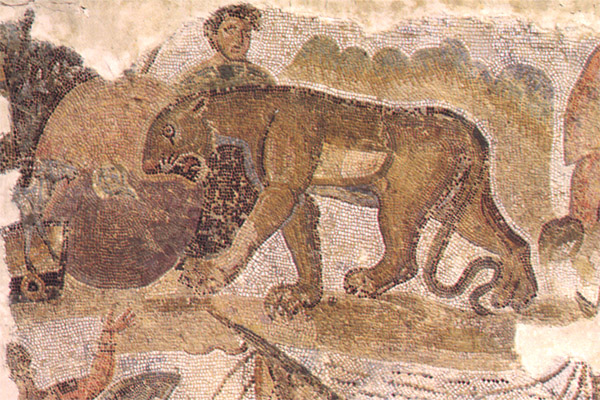
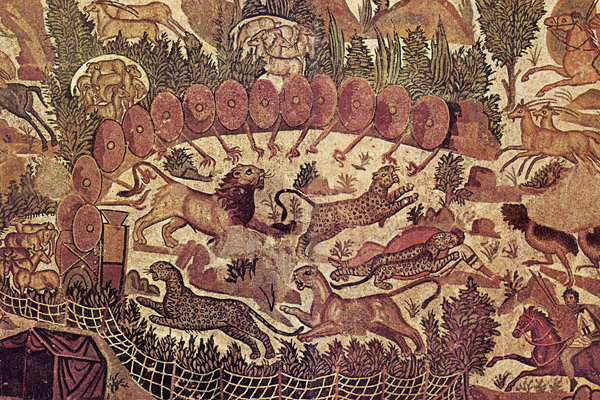
The first mosaic, which is in the Carthage Museum, shows a lioness being led on board ship, her handler safely behind a large shield. The second, which is from the late third century AD, shows how fiery brands were used to terrify the animals and is in the Musée Archéologique d'Hippone (Algeria).
Reference: Cicero: The Letters to His Friends (Vol. I) (1927) translated by W. Glynn Williams (Loeb Classical Library); Mosaics of Roman Africa: Floor Mosaics from Tunesia (1996) by Michèle Blanchard-Lemée, Mongi Ennaïfer, Hédi Slim, and Latifa Slim: The Story of the Roman Amphitheatre (2000) by D. L. Bomgardner.
