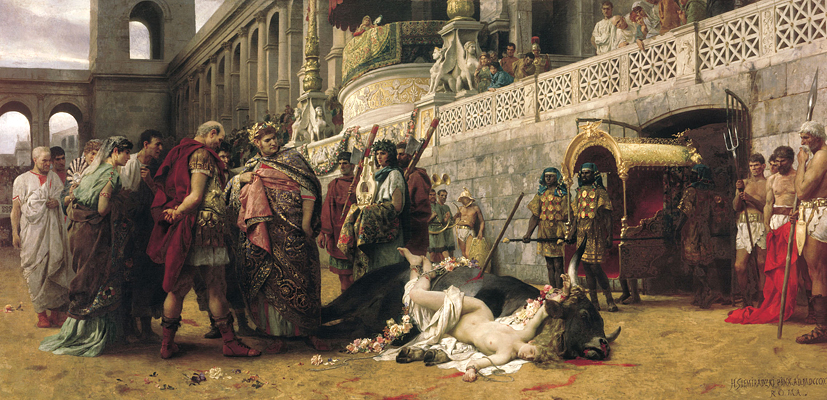
"To these men [Peter and Paul] who spent their lives in the practice of holiness, there is to be added a great multitude of the elect, who, having through envy endured many indignities and tortures, furnished us with a most excellent example. Through envy, those women, the Danaids and Dircæ, being persecuted, after they had suffered terrible and unspeakable torments, finished the course of their faith with steadfastness, and though weak in body, received a noble reward.
Clement of Rome, First Epistle to the Corinthians (VI.2)
Half a century after the anonymous account of the Pilgrim of Bordeaux, there was a second recorded pilgrimage to the Holy Land and the Biblical sites of the eastern Mediterranean. It was undertaken by Egeria, about whom nothing is known other than what can be gleaned from her account of the journey. She is presumed to have lived in a western province of the Roman Empire, possibly in Gaul somewhere along the Rhone, given her comparison of that river to the Euphrates. Or, because her pilgrimage was the subject of a letter written in the late seventh century AD by Valerius, a monk from Galicia in northwest Spain who exhorted the members of his community to emulate her devotion and piety, she sometimes is presumed to be from that region. Nor is it known whether she was a lady of the aristocracy, a member of a monastic order, or simply a devout laywoman, although she did have both the means and the education to undertake her pilgrimage.
In AD 384, on Egeria's return to Constantinople from Jerusalem, where she had stayed for three years, she visited the shrine of Thecla near Seleucia in southeastern Turkey. In the single fragmentary account of her itinerary, which was reported in a letter to a circle of pious women, her "sisters" back home, Egeria relates that the martyrium, "which is very beautiful," was surrounded by a great number of small monastic cells for pilgrims and worshipers, and by a wall to protect it from robbers. There, she prayed and "read the whole Acts of holy Thekla; and I gave heartfelt thanks to God for his mercy in letting me fulfill all my desires so completely, despite all my unworthiness."
The Acts of Thecla is a principal example of Christian romance and part of the apocryphal Acts of Paul and Thecla. Written sometime in the late second century AD (before its condemnation by Tertullian c. AD 200), the story of Thecla seems to have been an independent composition that later was incorporated (and substantially reworked) into the Acts of Paul, where her adventures occupy the middle third of the narrative.
Having traveled to Iconium in Asia Minor (cf. II Timothy 3:11, Acts 13:51ff), Paul was received into the home of a local Christian where, from a window in an adjacent house, his beatitude on chastity is overheard by Thecla, an eighteen-year old virgin. Enraptured, she listens to his words for three days and nights, ensnared as in a spider's web. Apprehensive that Thecla will harken to his call that "Blessed are the bodies of the virgins, for they shall be well-pleasing unto God," her fiancé incites a mob to take Paul before the proconsul, who has him imprisoned. But Thecla bribes the guards and, sitting at Paul's feet, kisses his chains and binds herself in affection. Paul again is brought before the governor. "But Thecla rolled herself [wallowed] upon the place where Paul taught when he sat in the prison" until she, too, is put on trial. Paul is sentenced to scourging and expulsion from the city, and Thecla to be burnt at the stake, her own mother crying out, "Burn the lawless one, burn her that is no bride in the midst of the theatre that all the women which have been taught by this man may be affrighted."
When Thecla is put naked on the pyre, the governor marvels at her beauty, but the fire is extinguished by a miraculous storm and Thecla escapes to reunite with Paul on the road, where they travel to Antioch. There, she is is noticed by Alexander, a nobleman who offers Paul gifts and money for her. When the apostle proclaims that he does not know the woman, the man attempts to take Thecla by force. Repulsing the assault, she tears his cloak and knocks the wreath from his head. Humiliated, Alexander brings her before the magistrate who, despite the protests of the women of the city, again condemns Thecla to death, this time ad bestias. Pleading to remain a virgin until her death, she is taken in by "a certain rich queen, Tryphaena by name," who had lost her own daughter. (Tryphaena was the widow of Cotys, King of Thrace, and a great-niece of the Emperor Claudius. Her brother briefly was married to Berenice, with whom a younger Titus had an affair. In Romans 16:12, Paul sends greetings to a Tryphena.)
Much like the image of Cybele, who was portrayed riding a lion, Thecla is seated upon a fierce lioness (which licks her feet) and paraded through the city. She is allowed to return to Tryphena, however, who, when Alexander himself comes for Thecla the next morning, escorts her to the arena. There, she is stripped and thrown to the beasts. Again, Thecla is preserved, this time by a lioness who defends her from the other animals (presumably, the one she had ridden the previous day). Praying, she baptizes herself in a large trench of water that miraculously has appeared (possibly the water-filled euripus that surrounded the arena is recalled), her nakedness covered by a cloud of fire--which also kills the vicious seals in the tank. (Earlier, Paul had advised Thecla to patiently defer her baptism.) Again, the women of the city protest and cast fragrant nard and balsam into the arena, which has a soporific effect on the animals.
"Alexander [who was sponsor of the show] said to the governor: I have some bulls exceeding fearful, let us bind the criminal [lady beast fighter] to them. And the governor frowning, allowed it, saying: Do that thou wilt. And they bound her by the feet between the bulls, and put hot irons under their bellies [genitals] that they might be the more enraged and kill her. They then leaped forward; but the flame that burned about her, burned through the ropes, and she was as one not bound" (Acts of Paul, XXXV; variously IX.12-13).
At this, Tryphena faints and the governor, thinking her dead, stops the spectacle, fearing that her relation to the emperor will bring destruction on the city. (Indeed, Alexander beseeches the governor to release the "lady beast fighter," the third time he has used the phrase to refer to her and the only instances in which the feminine form of the term occurs in Greek. The description is all the more curious in that Thecla never does fight any beasts; nor is she a martyr, not having died.) The women of Antioch rejoice and Thecla, refusing all entreaties to stay with the queen, converts her household and, longing for Paul, goes to rejoin him. He admonishes her to teach the word of God, and Thecla returns home to find that her fiancé has died and her mother, whom she tries to comfort, indifferent to her testimony. She then goes to Seleucia and preaches the gospel, dwelling in a cave for the next seventy-two years.
Among several pseudoepigraphical works attributed to Paul, including I and II Timothy and Titus (the Pastoral Epistles) and III Corinthians, the Acts of Paul and Thecla was known to be a forgery at the time. Tertullian makes the contention in his treatise On Baptism, no doubt to refute any justification that it offered for women to preach and baptize.
"But if certain Acts of Paul, which are falsely so named, claim the example of Thecla for allowing women to teach and to baptize, let men know that in Asia the presbyter who compiled that document, thinking to add of his own to Paul's reputation, was found out, and though he professed he had done it for love of Paul, was deposed from his position. How could we believe that Paul should give a female power to teach and to baptize, when he did not allow a woman even to earn by her own right? Let them keep silence, he says, and ask their husbands at home" (XVII.5; cf. I Corinthians, 14:35, "And if they will learn any thing, let them ask their husbands at home: for it is a shame for women to speak in the church").
Jerome, too, referring to Tertullian, considered the Acts to be apocryphal, "for how is it possible that the inseparable companion of the apostle in his other affairs, alone should have been ignorant of this thing. Moreover Tertullian who lived near those times, mentions a certain presbyter in Asia, an adherent of the apostle Paul, who was convicted by John of having been the author of the book, and who, confessing that he did this for love of Paul, resigned his office of presbyter" (De Viris Illustribus, VII).
If there is patristic misogyny regarding the Acts of Thecla, a prejudice against the stories of women in general can be discerned as well. The author of I Timothy admonishes the reader to "refuse profane and old wives' fables, and exercise thyself rather unto godliness" (4:7) and criticizes widows who "learn to be idle, wandering about from house to house; and not only idle, but tattlers also and busybodies, speaking things which they ought not" (5:13). Clement of Alexandria also warns against those who would spend time with disreputable old women, who "keep up old wives’ whisperings over their cups, learning charms and incantations from soothsayers, to the ruin of the nuptial bonds" (Paedagogus, III.4). Writing somewhat earlier than the Acts, Apuleius, too, speaks of an old woman seeking to console a younger one who had been kidnapped by thieves on the day of her marriage by telling her "a pleasant old wives' tale to put away all thy sorrow and to revive thy spirits" (Metamorphoses, IV.27; what Augustine himself called "The Golden Ass," De Civitate Dei , XVIII.18).
All this having been said, the story was regarded by many church fathers as legitimate, even if emphasis shifted from her claim to preach to her virginity and martyrdom. Ambrose, the bishop of Milan, for example, commends Thecla, the city's patron saint, to his sister as an example of both (On Virginity, II.3). Finally, in gratitude for a vision from the martyr and victory over the usurper Basiliscus, the emperor Zeno dedicated in the late 470s "a hugh sanctuary of outstanding beauty and magnificence" at Thecla's shrine which he adorned with "very many imperial dedications, which are preserved even in our time" (Evagrius Scholasticus, Ecclesiastical History, III.8). This account, written a hundred years later, seems to be the last reference to devotion at the cult site.
The story of Thecla had been rooted in oral tradition until it was incorporated in The Acts of Paul and Thecla. In time, it became detached from this narrative and was transmitted independently, as when Egeria writes that she read The Acts of Saint Thecla when visiting her shrine. Another is The Life and Miracles of Saint Thecla, written almost three hundred years later (sometime between AD 444-448) that paraphrases and expands upon the original account, and gathers together a collection of forty-six miracles that themselves had been told by pilgrims over the previous century.
Although a Christian romance, the story of Thecla permits some inferences about the social world of the storytellers themselves and the values that were espoused by Christians in the second century AD. Chastity and asceticism, for example, are esteemed. A public ministry as an itinerant teacher and the right to travel freely in that calling also may have been social options for women. Indeed, Thecla's commitment to chastity and physical purity is the source of her spiritual power, her charisma. It is this charismatic authority that allows her to assume the role of confessor, that is, one who has publicly confessed one's faith and been willing to endure suffering and death in the name of Christ. Tryphaena, for example, in the belief that the trials undergone by Thecla have given her the power to forgive sins, asks that she pray for her dead daughter that she might attain eternal life. (The martyred Perpetua also prays for her diseased brother and in a vision sees him delivered from his suffering.)
The final act of the confessor was martyrdom. With death, the priestly authority of the martyr ended as well (conveniently, one suspects, for the local bishops and presbyters who claimed such privilege for themselves). Thecla was not a martyr nor did she die; rather, it is her charisma that has allowed her to baptize herself in the arena and assume the role of confessor.
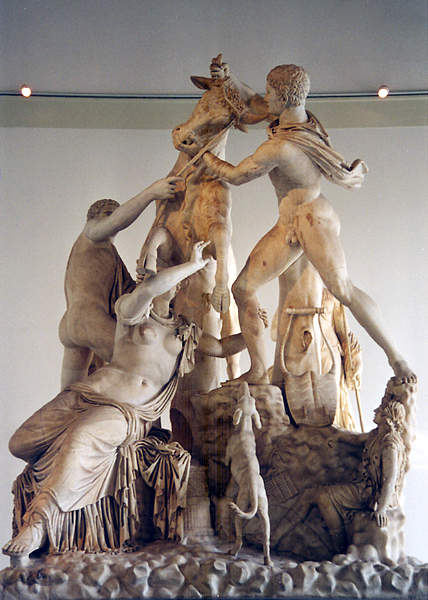
"Asinius Pollio, being an ardent enthusiast, was accordingly anxious for his collection to attract sightseers. In it are....a composition by Apollonius and Tauriscus which was brought from Rhodes, namely Zethus and Amphion, and then Dirce and the bull with its rope, all carved from the same block of stone."
Pliny, Natural History (XXXVI.34)
The myth of Dirce is related by Apollodorus in his Bibliotheca (III.5.5; also Hyginus, Fabulae, VII, VIII). In the guise of a satyr, Zeus seduced the beautiful Antiope, a princess of Boeotia, who, threatened by her disgraced father, flees to Sicyon and marries its king. Despondent, the father kills himself. The city is besieged by Lycus, her father's brother and now ruler of Thebes, who kills the king and takes Antiope captive. Twin sons, Zethus and Amphion, to whom she has given birth, are exposed (but taken in by a shepherd) and Antiope herself given over to Dirce, the wife of Lycus, who treats her shamefully. When Antiope learns that her grown sons are alive, she flees, asking that they avenge her mistreatment. Lycus is killed and Dirce tied to a bull. The sons assume rule of Thebes, build its seven-gated walls (the stones following Amphion's lyre while Zethus staggers under his load, cf. Apollonius, Argonautica, I.735ff; Horace, Art of Poetry, 394; Pausanius, IX.5.7) and honored as founders of the city. (It is the sons and daughters of Amphion's wife Niobe who are killed when their mother so imprudently boasted that she had more children than Leto, the mother of Apollo and Artemis.)
Ambrose (De Virginibus, II.3.19-20).
"Let, then, holy Mary instruct you in the discipline of life, and Thecla teach you how to be offered, for she, avoiding nuptial intercourse, and condemned through her husband’s rage, changed even the disposition of wild beasts by their reverence for virginity. For being made ready for the wild beasts, when avoiding the gaze of men, she offered her vital parts to a fierce lion, caused those who had turned away their immodest looks to turn them back modestly. The beast was to be seen lying on the ground, licking her feet, showing without a sound that it could not injure the sacred body of the virgin. So the beast reverenced his prey, and forgetful of his own nature, put on that nature which men had lost. One could see, as it were, by some transfusion of nature, men clothed with savageness, goading the beast to cruelty, and the beast kissing the feet of the virgin, teaching them what was due from men. Virginity has in itself so much that is admirable, that even lions admire it. Food did not induce them though kept without their meal; no impulse hurried them on when excited; anger did not exasperate them when stirred up, nor did their habits lead them blindly as they were wont, nor their own natural disposition possess them with fierceness. They set an example of piety when reverencing the martyr; and gave a lesson in favor of chastity when they did nothing but kiss the virgin’s feet, with their eyes turned to the ground, as though through modesty, fearing that any male, even a beast, should see the virgin naked."
The marble statue of Dirce above is the largest sculptural group to survive from antiquity. Known as the Farnese Bull, it was discovered in 1545, when Pope Paul III excavated the Baths of Caracalla in search of art works to adorn the Palazzo Farnese, where, heavily restored (none of the heads, except that of the bull and the shepherd, for example, are original), it was to serve as a fountain. In 1789, after the death of Charles III, the son of Philip V and his second wife Elizabeth Farnese, it was transported to Naples, where again it served as the centerpiece of a fountain. There was concern, however, about the affect of the sea air on the marble, and by 1826 the statue had been moved to the National Archaeological Museum (Naples).
If the statue is the one described by Pliny, it would have been one of the late Hellenistic works displayed in the Atrium Libertatis of Asinius Pollio (Suetonius, Life of Augustus, XXIX.5; the "Hall of Liberty" also was the site of Rome's first public library, Ovid, Tristia, III.1.71-72; Isidore, Etymologies, VI.5.2). But more likely it dates to the Severan period (early third century AD) and is an adaptation of the Rhodian prototype carved specifically for the Baths of Caracalla.
Christian Dirce (1897) top is by Henryk Siemiradzki and in the National Museum (Warsaw).
References: The Cult of Saint Thecla: A Tradition of Women's Piety in Late Antiquity (2001) by Stephen J. Davis; The Apocryphal New Testament (1924) translated by M. R. James; Animals in the Apocryphal Acts of the Apostles: The Wild Kingdom of Early Christian Literature (2008) by Janet E. Spittler (Wissenschaftliche Untersuchungen Zum Neuen Testament, 247); Tertullian's Homily on Baptism (1964) translated by Ernest Evans; A Select Library of Nicene and Post-Nicene Fathers of the Christian Church, Series II (1890-1896) edited by by Philip Schaff and Henry Wace; "Thecla and the Church Fathers" (1994) by Léonie Hayne, Vigiliae Christianae, 48(3), 209-218; Hellenistic Sculpture II: The Styles of ca. 200-100 B.C. (2008) by Brunilde Sismondo Ridgway; Egeria's Travels (1999) translated by John Wilkinson; "Who Was Egeria? Piety and Pilgrimage in the Age of Gratian" (1988) by Hagith Sivan, The Harvard Theological Review, 81(1), 59-72; "Holy Land Pilgrimage and Western Audiences: Some Reflections on Egeria and Her Circle" (1988) by Hagith Sivan, The Classical Quarterly, 38(2), 528-535; The Ecclesiastical History of Evagrius Scholasticus (2000) translated by Michael Whitby; The Life and Miracles of Thekla: A Literary Study (2006) by Scott Fitzgerald Johnson.
See also St. Eulalia, Perpetua, and Montanism.
