"Nor did the fire fall upon the vessels only: the houses near the sea caught fire from the spreading heat, and the winds fanned the conflagration, till the flames, smitten by the eddying gale, rushed over the roofs as fast as the meteors that often trace a furrow through the sky, though they have nothing solid to feed on and burn by means of air alone."
Lucan, Pharsalia (X.497ff)
Julius Caesar himself provides the first indication of what might have happened to the Great Library at Alexandria. In the Civil Wars, he recounts the Battle of Pharsalus (48 BC) and his pursuit of the defeated Pompey to Alexandria, where Caesar became embroiled in the Alexandrian War between Cleopatra and her younger brother, Ptolemy XIII. There was an attempt by the Egyptians to seize the ships in the harbor, the recovery of which would have jeopardized any hope for supplies and reinforcement. Besieged and desperate, Caesar "burned all these vessels and those in the dockyards, since he could not protect so wide an area with his small force" (III.111) and retreated during the fighting to the island of Pharos, which was seized. He then garrisoned the Pharos itself, the famed lighthouse "of great height, a work of wonderful construction, which took its name from the island" (III.112). Access to the sea having been secured, a cordon was drawn around the most important positions, including the adjoining Theater, which commanded access to the harbor. During the night, defensive barriers were established and later strengthened.
Here, Caesar's account ends but is continued by Aulus Hirtius, one of his lieutenants. Battering rams were used to knock down buildings on the island and the barriers extended. Hirtius then interjects that "Alexandria is almost completely secure against fire; the buildings have no carpentry or timber, and are composed of masonry constructed in arches and roofed with rough-cast or flag-stones" (The Alexandrian War, I). It is an unexpected observation and, in remarking that Alexandria could not burn, Hirtius may have been trying to counter accusations that it had. Certainly, the town ignited readily enough in the later fires of Aurelian and Diocletian.
There seems, too, to have been a ready supply of fuel. Hirtius speaks of siege towers being constructed, each ten stories high (II), and later comments on the native ingenuity of the Alexandrians (XIII), who were able to acquire enough wood by dismantling the roofs of colonnades, gymnasia, and other public buildings to replace a shortage of oars and even to build or repair more than two dozen large warships, both quadriremes and even a few quinqueremes. Reading these earliest accounts, it is as if both authors tacitly are apologizing for something that neither expected to have happened: the accidental burning of the Library itself—Caesar protesting that he was compelled to set fire to the ships in the harbor, and Hirtius denying that the city could catch fire as well.
Twenty years later, in about 24 BC, Strabo accompanied his friend Aelius Gallus, the new Roman prefect, to Egypt and toured the province (Geography, II.5.12). Strabo was to stay there for four years and reside in Alexandria, which he describes in detail. Opposite the Pharos was the Lochias promontory and its royal palace and then, further on, "the inner royal palaces, which are continuous with those on Lochias and have groves and numerous lodges painted in various colours" (XVII.1.9). This warren of buildings, monuments, and public spaces extended along the eastern shore and comprised a quarter or even a third of the city, all built up by successive kings and connected with one another and to the harbor (XVII.1.8). Here were the Theater and Temple of Poseidon, the Caesareum, Emporium, and warehouses. Finally, there were the ship-houses, which extended as far as the causeway that connected Pharos to the mainland.
The Mouseion ("a shrine of the muses," in Latin, museum) was "a part of the royal palaces" (XVII.1.8) and, like Aristotle's Lyceum upon which it was based, had a colonnaded walkway (peripatos, after which the Peripatetic philosophers were named), exedra with seats, and a large communal building with a refectory or dining hall for the "men of learning" (philologoi, philologists or "lovers of words") who shared the Museum in common. In charge was a priest, formerly appointed by the Ptolemies but now by the emperor Augustus. It likely had been dedicated by Ptolemy II Philadelphus in about 283 BC, when he succeeded his father and became sole ruler of Egypt.
The Museum, which was a major attraction of Alexandria (Herodas, Mimes, I), is presumed to have had a library, where scrolls by Homer and the Athenian playwrights would be readily accessible to scholars who were "at the same time poet and critic," as Philitas of Cos was described in the reign of Ptolemy I Soter (Geography, XIV.2.19). But whether the Library of Alexandria comprised a collection within the Museum itself or occupied a separate building is not known, although the ruins of the library at Pergamum suggest that it was part of the Museum complex.
A zoo that sometimes is affiliated with the Museum was the royal menagerie of Ptolemy II. Among its exotic animals, "which had never before been seen and were objects of amazement" (Diodorus Siculus, Library of History, III.36.3, 5), was a snake more than fifty feet long. Such creatures were called boas, says Isidore of Seville, because they killed cattle and oxen (boves) by entwining themselves around the udders and sucking them dry (Etymologies, XII.4.28; Pliny, Natural History, VIII.xiv.36ff). Animals both wild and domestic were displayed in a grand procession that may have been part of the Ptolemaieia, a quadrennial festival introduced by Ptolemy in 278 BC. There were elephants, antelopes, hartebeests, ostriches, zebras, and wild asses, as well as caged parrots, peacocks, and pheasants. The parade ended with a white bear, leopards, genets, caracals, and the two rarest species in captivity at the time—a rhinoceros and a giraffe (Athenaeus, Deipnosophistae, V.201C).
Strabo does not specifically mention the Library in his description of the Museum, although he does say, in defense of his predecessor Eratosthenes (its third director), that the geographer had read many historical treatises "with which he was well supplied if he had a library as large as Hipparchus says it was" (II.1.5), implying that, since that time, it greatly had diminished or even no longer existed. But Strabo also speaks of making a comparison between two different authors to discover who might have copied the other (XVII.1.5), which suggests that he did have access to a book collection, if not in the Library then in the Serapeum or Caesareum.
By the time of Strabo's visit, more than two decades after the fire, the demolished buildings on Pharos still had not been rebuilt and, aside from a few seamen who lived near the lighthouse, the island was uninhabited, having "been laid waste by the deified Caesar in his war against the Alexandrians" (XVII.1.6). It is not clear whether the royal district on the opposite shore, of which the Museum was a part, was destroyed as well. Caesar, who resided in "a small part of the palace" (Civil Wars, III.112), was besieged there while fighting continued in the streets and a more desperate battle was fought at the port. That he was able to fortify his position implies that this area of town escaped the fire. Strabo at least makes no mention of any further destruction.
Dismissive of the importance of "numberless books and libraries, whose titles their owner can hardly read through in a lifetime," the younger Seneca quotes from a lost book by Livy (Periochae 112.6) that a library is "a splendid result [pulcherrimum monumentum] of the taste and attentive care of the kings" (On the Tranquility of the Mind, IX.5). The phrase translates as "most beautiful monument," which coincidentally are the same words used by Cassiodorus to describe the wondrous Mausoleum at Halicarnassus (Variae, VII.15.4). Seneca then rejoins that, if "forty thousand books were burned at Alexandria," they had been collected merely for ostentatious display. This passing remark, written sometime after his return from exile in AD 49 to tutor the young Nero, is the first indication that books (libri) actually had been destroyed in the Caesarean fire a century before. Seneca does not say where these books were lost, but the context implies that they were in the Library.
The Stoic philosopher is admonished by Gibbon for his flippancy, "whose wisdom, on this occasion, deviates into nonsense" (Decline and Fall, L). Curiously, Gibbon himself later hints at the same sentiment: the notion that veritas filia temporis, "truth is the daughter of time" (Aulus Gellius, Attic Nights, XII.11.7). It was a belief, beginning with the Greek tragedians, that truth is revealed in time and only the false and unworthy perish. As Gibbon phrases it: "Yet we should gratefully remember, that the mischances of time and accident have spared the classic works to which the suffrage of antiquity had adjudged the final place of genius and glory...nor can it fairly be presumed that any important truth, any useful discovery in art or nature, has been snatched away from the curiosity of modern ages" (Decline and Fall, LI). Would that it were so.
Suspected in a plot against Nero, Seneca was forced to commit suicide—as was his nephew Lucan, author of his own Civil War (Pharsalia), an unfinished epic of the Roman upheaval. Lucan relates how the Alexandrians, unable to breach the gates, attacked the walls of the palace, assaulting it "at the point where the splendid pile projected with bold frontage right over the water" (X.486ff). Caesar ordered firebrands to be hurled against the ships, the wind fanning flames that spread to the roofs of nearby houses. When the besiegers rushed to fight the fire, he escaped to the Pharos. Here the poem ends, at almost the same point as Caesar's own account.
Florus later relates the same event in his epitome of Livy. Caesar thwarted his assailants "by setting fire to neighbouring buildings and docks" and then, making a sudden sally, occupied the Pharos (Epitome of Roman History, II.13.59).
Like Florus, Plutarch wrote during the reign of Hadrian (early in the second century AD). He agrees that Caesar's situation was dire and recounts that "when the enemy tried to cut off his fleet, he was forced to repel the danger by using fire, and this spread from the dockyards and destroyed the great library [megale bibliotheke]" (Life of Caesar, XLIX.6). This is the first mention that Caesar himself destroyed the Library and not simply its books. Plutarch had visited Alexandria (Quaestiones Convivales, V.5.1), perhaps after AD 83, when there was an eclipse (or earlier, since his grandfather still was alive when he returned), and may have seen the Library, although he says nothing more about it. Nor does Appian, writing sometime before AD 162, who comments only that "various battles took place around the palace and on the neighbouring shores" (Civil Wars, II.90).
Early in the third century AD, Dio Cassius elaborated on what had happened. "Many battles occurred between the two forces both by day and by night, and many places were set on fire, with the result that the docks and the storehouses of grain among other buildings were burned, and also the library, whose volumes [biblia], it is said, were of the greatest number and excellence" (Roman History, XLII.38.2). This is the Loeb translation; another is provided by Hatzimichali: "Many things were set fire to, with the result that the dockyards and the storage-places [apothekas] were burnt, both those of grain and of books; the latter were very numerous and most excellent, as they say."
Galen refers to such warehouses in his commentary on the third book of Hippocrates' Epidemics. Books arriving in Alexandria were not immediately placed in the Library but first deposited in storehouses (apothekai, from which "apothecary" is derived). The same word is used by Lucian (in the sense of a storeroom within a larger building) when he satirizes the pretension of an ignorant book collector who presumes that his "very book-cases [apothekas] acquire a tincture of learning, from the bare fact of their housing so many ancient manuscripts" (Adversus Indoctum, V).
Finally, writing in the fifth century AD, Orosius speaks of books "stored in a building which happened to be nearby" (Historiarum Adversum Paganos Libri VII, VI.15.31ff), although it is not clear whether they were there by chance.
During the summer, a strong Etesian wind blows inland from the sea (Geography, XVII.1.7; also Diodorus Siculus, Library of History, XVII.52.2) which, as Caesar complained, had prevented him from sailing out of the harbor (Civil Wars, III.107). This is a bit disingenuous, as in the previous sentence, he had ordered that help be sent from Asia. Fifty ships were moored there, both quadriremes and quinqueremes, all fitted out and ready to sail, as well as another twenty-two decked ships (III.111). Altogether, relates Hirtius, more than one hundred ten ships, either at anchor or tied up at the quay, were lost (Alexandrine War, I.12). It was late August and, from Lucan's poetic description of the tarred rigging and waxed decks catching fire, it is easy to imagine burning embers being blown across the harbor onto the wharves, dockside warehouses and granaries, the roofs of nearby houses—and the Great Library itself. The many other places said by Dio to have been set on fire would only have added to a conflagration unlikely to have been contained by men desperately fighting "with the intense eagerness that was bound to occur when the one side saw a speedy victory, the other their own safety" (Roman History, III.111).
There is a sanguine note, however. In 41 BC, Mark Antony, in an extravagant gesture to his inamorata Cleopatra, "bestowed upon her the libraries from Pergamum, in which there were two hundred thousand volumes" (Plutarch, Life of Antony, LVIII.5), each representing the work of a single author. So outrageous was the gift to Roman sensibilities that it was one of a litany of complaints directed against Antony. Although many of these accusations were thought to have been false (LIX.1), the volumes (volumina) certainly would have mitigated the loss from a few years before.
It also would explain how later authors could comment on the destruction of the Library and yet imply that its scrolls still were being copied. In AD 80, a devastating fire burned "the Octavian buildings [Portico of Octavia] together with their books" (Roman History, LXVI.24.1); shortly before, a library associated with the Temple of Augustus had burned as well (Pliny, Natural History, XII.xlii.94). These libraries were restored by Domitian, "at very great expense, seeking everywhere for copies of the lost works, and sending scribes to Alexandria to transcribe and correct them" (Suetonius, Life of Domitian, XX; also Martial, XII.3.7-8). Perhaps because the emperor himself was indifferent to history or poetry, the largess is unexpected and remarked upon by Aurelius Victor in the fourth century AD. "With exemplars sought from everywhere, especially Alexandria, he restored libraries consumed by fire" (De Caesaribus, XI.4).
There also are later references to the Museum. Claudius, who ruled from AD 41 to 54, "added to the old Museum at Alexandria a new one called after his name," provided that the twenty books of his Etruscan history be read each year from beginning to end (Suetonius, Life of Claudius, XLII.2). These "modern professors in the Claudian Institute" are mentioned too by Athenaeus, where a playwright compares them to a School for Parasites (Deipnosophistae, VI.240B).
A Latin inscription records that Tiberius Claudius Balbillus, prefect of Egypt (Tacitus, Annals, XIII.22) from AD 55 to 59, was director of the Library, a sinecure presumably awarded in recognition of imperial service. Balbillus was the grandfather of Julia Balbilla, who later accompanied Hadrian and his wife during their visit to Egypt in AD 130. In Thebes, four of her epigrams were scratched on a statue of Memnon commemorating the occasion. And in Alexandria, Hadrian visited the Museum and "propounded many questions to the teachers and answered himself what he had propounded" (Historia Augusta, XX.2). Hadrian also enrolled a favorite in the Museum so he could enjoy free meals there (Philostratus, Lives of the Sophists, 524). And an Oxyrhynchus papyrus records the sale in AD 173 of a boat by a certain Valerius Diodorus, "member of the Museum."
Aulus Gellius, who died sometime after AD 180, is the first to admit that the destruction of the Library was unintentional. "At a later time an enormous quantity of books, nearly seven hundred thousand volumes, was either acquired or written in Egypt under the kings known as Ptolemies; but these were all burned during the sack of the city in our first war with Alexandria, not intentionally or by anyone's order, but accidentally by the auxiliary soldiers" (Attic Nights, VII.17.3).
Athenaeus, writing early in the third century AD (after AD 228, if the Ulpian who hosts the symposium is modeled on the celebrated jurist who was murdered that year), seems to imply that the Museum at Alexandria and its well-fed pedants endlessly quarreling in "the Muses' bird-cage" (I.22D) were a thing of the past. "And concerning the number of books, the establishing of libraries, and the collection in the Hall of the Muses, why need I even speak, since they are in all men's memories?" (V.203D). Or the remark could be understood to mean that the Library was so famous that nothing more need be said about it.
The figure of Gellius is repeated by Ammianus Marcellinus, who lived at least until AD 391, the year that the Temple of Serapis in Alexandria was destroyed. Ammianus thinks it still to be standing; indeed, "the whole world beholds nothing more magnificent" (Res Gestae, XXII.16.12). But he mistakenly conflates the Serapeum and the Great Library: "In this were invaluable libraries, and the unanimous testimony of ancient records that 700,000 books, brought together by the unremitting energy of the Ptolemaic kings, were burned in the Alexandrine war, when the city was sacked under the dictator Caesar" (XXII.16.13). (In the same excursus on Egypt, Ammianus also thought that the Pharos had been built by Cleopatra, as well as the causeway, which was constructed in only seven days so that the island, too, could regarded as part of her domain. But he may have confused this exercise with the queen's attempt to repair the damage caused during Caesar's defense of the island.)
Ammianus continues his account of Alexandria "the crown of all cities" (XXII.16.7), which he probably visited on his trip to Egypt, by telling of the civil war that later raged there during the reign of Aurelian, who recaptured the city occupied by those loyal to Zenobia, queen of Palmyra, in AD 273. "The quarrels of the citizens turned into deadly strife; then her walls were destroyed and she lost the greater part of the district called Bruchion, which had long been the abode of distinguished men," including Aristarchus, "eminent in thorny problems of grammatical lore" (XXII.16.15; Zosimus, New History, I.61: "the Alexandrians, who were disposed to a rebellion, being already in commotion"). If the Library was not destroyed in the Caesarean fire, the assumption is that it surely must have been during the conquest of Aurelian more than three centuries later. (The revolt had been led by Firmus, a rich merchant who was said to have "owned so many books that he used often to say in public that he could support an army on the paper and glue," Historia Augusta, III.2.)
In AD 298, twenty-five years after the destruction of the Bruchion (the royal precinct) by Aurelian, Alexandria again was put to the torch by Diocletian who, after an eight-month siege, "set fire to the city and burnt it completely, and he established his authority over it" (John of Nikiu, Chronicle, LXXVII.6). John Malalas relates that Diocletian swore to slaughter the inhabitants until their blood reached the knees of his horse. Only when it stumbled over a corpse did the carnage end and a pardon granted (Chronicle, XII.41). In gratitude, the Alexandrians erected a bronze statue to the horse. A huge column also was placed on the Acropolis that still marks the site. It was here at the Serapeum that a second library existed—a "daughter" or annex to the Great Library.
Almost a century later, the Bruchion still had not recovered from these depredations. An editor's footnote to Gibbon says that after its destruction by Aurelian, the district no longer was even included within the city walls but regarded as a suburb. In AD 392, Epiphanius records that the once royal quarter of the city was a wasteland (On Weights and Measures, IX.52b). And Jerome, writing two years before, speaks of an anchorite living there, who "because he never stayed in cities since he entered on the monk's life...turned aside to some brethren at Bruchium, not far from Alexandria" (Life of St. Hilarion, XXXIII).
Libri, volumina, and Greek biblia all were used to describe papyrus book rolls, but it is not always clear how many books (in the modern sense of an author's composition bound in a volume) were contained in a scroll—whether a single complete work, parts of one, or several shorter works. A scroll often contained only one "book" of an ancient work and was the equivalent of a modern chapter (which themselves often are still called books). The Iliad, for example, is a book by Homer but was divided into twenty-four chapters or cantos, each represented by a single scroll.
Seneca (the first to mention a number) says that 40,000 libri were destroyed. Gellius and Ammianus, using a different source than Livy, record the loss of 700,000 volumina. Later ecclesiastical authors cite multiples of these figures: Orosius, who wrote about AD 416, 400,000 books (Historiarum Adversum Paganos Libri VII, VI.15.31ff) and Isidore of Seville (d. AD 636), 70,000 (Etymologies, VI.3.5). This confusion between 40,000 and 400,000, and 70,000 and 700,000 strongly suggests an error by the medieval copyist (different manuscripts preserve all of these numbers). It would take only a horizontal line over the Roman numeral C in the original manuscript, for example, to indicate a multiple by a thousand or an inattentive copyist to confuse quadraginta (40) with quadringenta (400).
In the twelfth-century, the Byzantine scholar Johannes Tzetzes, referring to Ptolemaic sources, wrote a scholia on the comedies of Aristophanes in which he states that there were 400,000 mixed rolls inside the palace quarter (presumably miscellanea comprising more than one work, either from the same or different authors) and 90,000 unmixed rolls (one work). Another 42,800 were outside (in the Temple of Serapis)—for a total of 532,800 scrolls (Prolegomena on Comedy, XX).
Epiphanius, who also speaks of two libraries, one in the Bruchion and a second in the Serapeum, says that there had been 54,800 scrolls (On Weights and Measures, XI.52c), a tenth of that number. Josephus records that originally there were 200,000 (Antiquities of the Jews, XII.2.1), a figure he takes from the Letter of Aristeas (X), a late second-century BC pseudepigraphical text that is the earliest to mention the Library and the size of its collection, the purpose of which was to collect "all the books in the world" (IX).
Even though there likely were multiple copies of the same work, Blum is doubtful whether the Great Library ever grew to the size stated by Tzetzes; indeed, it is "inexplicable." He calculates that 400,000 scrolls would require that two thousand Greek authors each wrote ten works averaging twenty scrolls apiece. Bagnall, too, questions the plausibility of such large numbers, assuming that the hundreds of thousands of scrolls actually ever were counted or even read. By the same token, the 200,000 volumes said to have been given by Antony to Cleopatra seem improbably high, especially if they each represented the work of a single author.
Vitruvius does recount, however, the story of Aristophanes of Byzantium, "who with great labour and application was day after day reading through the books in the library." When the winner of a poetry contest was about to be announced, only Aristophanes disagreed with the other judges. Relying on his memory, he "quoted a vast number of books on certain shelves in the library, and comparing them with what had been recited, made the writers confess that they had stolen from them." The plagiarists were prosecuted for theft and dismissed; Aristophanes was appointed director of the Library (On Architecture, VII, Preface, 4ff).
Bagnall posits that about 450 Greek authors (the Library held only works in Greek; other languages were translated) are known to have lived or were born in the fourth century, many of whom are known from only a few surviving lines of text. Another 175 lived or were born in the third century BC (when the Library was founded), who probably wrote only a few scrolls. Even if all these authors are allowed to have produced an average of fifty scrolls, their output would total only 31,250, which is fewer than even the lowest number given by Seneca. Bagnall further contends that about 3,773,000 words survive in Greek from authors who lived from the second to the fourth centuries BC, or before (a figure calculated from the Thesaurus Linguae Graecae, a searchable database of virtually all surviving texts in Greek from Homer to the fall of Constantinople in 1453, and later). Allowing an average of ten thousand words per scroll, this corpus comprises a mere 377 scrolls. Even if this estimate is too low and a hundred times more writings existed than have survived, the number still is less than Seneca's. In short, Bagnall concludes that "the ancient figures for the size of the Library or the number of volumes lost in the Alexandrine War do not deserve any credence."
Other authors have tried to calculate the number of scrolls in the Library by estimating those listed in the Pinakes of Callimachus, the complete title of which is Tables of Men Distinguished in Every Branch of Learning, and their Works in 120 books (Suda, K227), an index of authors, a brief biography, and their work (including the approximate number of lines), divided into genres and listed alphabetically. Allowing forty-four lines per column and twenty-seven columns per scroll, Bagnall calculated 142,560 lines in total. If two thirds of these lines are allocated just for titles, there would have been approximately 94,000 in the Library. McKenzie posits different variables: assuming that each scroll was eight meters long with forty lines per column and three lines per entry, she estimates that there were 128,000 scrolls.
Certainly, many were written, and it still is difficult to reconcile these modern estimations with ancient accounts. The grammarian Didymus of Alexandria, a contemporary of Cicero, was said to have composed thirty-five hundred books, so many that he could not remember them all and so was given the epithet Bibliolathas ("book forgetter") (Athenaeus, 139D, who himself cites almost eight-hundred authors). "Unsurpassed for the number of books which he wrote," Didymus once was criticized for declaring a story to be absurd only to have forgotten that he had repeated it himself (Quintilian, Institutio Oratoria, I.8.20). Seneca the Younger gives the figure as four thousand libri (Epistles, X.88.37), which was such a prodigious number that Didymus also was called Chalcenterus ("bronze guts") because of his "indefatigable industry with regard to books" (Suda, D872)—which must have been accessible to him.
As to libraries, a Greek sophist living in first-century Rome purchased more than thirty thousand books (Suda, T1184; another Greek in the time of Nero was said to have done the same, 2004E). The tutor to Gordian II supposedly bequeathed to the emperor more than twice that number at his death, an estimated sixty-two thousand books (Historia Augusta, XVIII.2). Diogenes Laertius relates that Theophrastus, a student of Aristotle, left "a very large number of writings," which, given their excellence, he felt compelled to catalog. Approximately 225 titles are listed, which comprised an even greater number of scrolls and totaled 232,808 lines (V.36ff; Aristotle himself wrote fewer titles but almost twice the number of lines: 444,270, V.1ff). Euripides is another example of all that has been lost. Of ninety-two plays that were written, seventy-eight were known to Alexandrian scholars, and only eighteen survive, which still is more than twice the number of either Aeschylus or Sophocles.
Curiously, the Library and the Museum never are mentioned together, only one or the other. Caesar speaks of the fire but not the Library; Strabo, the Museum but not the fire; Seneca, the fire and the loss of books but not the Library; Plutarch, the Library but not the books; Dio, the fire and the Library; Florus, the fire but not the Library or its books; and Appian, neither the fire, Library, or books—only the battle. As the account of the fire is repeated, so too are its consequences ever more disastrous. In the first century AD, Seneca mentions the loss of 40,000 books; in the second century, Aulus Gellius, almost 700,000; in the third century, Dio, the loss of books "of the greatest number and excellence"; in the fourth century, Ammianus, the burning of a priceless library and 700,000 books; and in the fifth century, Orosius, 400,000 books and the destruction of that "marvelous monument of the literary activity of our ancestors, who had gathered together so many great works of brilliant geniuses."
Insofar as the destruction of the Great Library had a single cause, Plutarch and Ammianus attribute it to Caesar; and Seneca, Dio, Gellius, and Orosius, the Caesarean fire. (Blum declares that "There is no doubt that either part or all of the library perished in the flames at that time.") If so, the loss has to be reconciled with later references to both the Museum and the Library, which, in turn, requires that the two be considered separate entities (the contention of El-Abbadi and the Oxford Classical Dictionary) or that the scrolls were not completely lost, replaced if they were, or to be found in other book collections.
Apologists have suggested that the apothekai of Dio and Galen were no more than storehouses. But as Isidore of Seville explains, "a library takes its name from Greek, because books are deposited there" (Etymologies, VI.3.1); in that sense, bibliotheke (Latin bibliotheca) and apotheke both are repositories for books. The question is whether a distinction is to be made between them. If so, it is odd that Dio feels compelled to lament the incidental loss of dockside merchandise and not the Library itself, especially since he uses apothekai to refer to the libraries in the Temple of Apollo on the Palatine (LIII.1.3) and the Portico of Octavia (XLIX.43.8).
If not stored for accessioning, then it is argued that the books were for Caesar himself, who intended "to open to the public the greatest possible libraries of Greek and Latin books, assigning to Marcus Varro the charge of procuring and classifying them" (Suetonius, Life of Caesar, XLIV.2). But when Caesar arrived in Alexandria, he had with him only two weakened legions, comprising thirty-two hundred men and eight hundred horse (Civil Wars, III.106). Besieged in a hostile city by an army of twenty-thousand infantry and two-thousand cavalry (III.110), it hardly seems credible that he would preoccupy himself with exporting tens of thousands of scrolls to Rome.
The assumption, too, is that, if the Library had been destroyed, Caesar, Hirtius, Cicero, and Strabo all would have commented upon the fact. Delia, for example, makes this argument, contending that "the silence of that omnivorous bibliophile and gossip, Cicero, cannot be similarly ignored [as could that of Hirtius]; on the contrary, it is compelling." But this is an argumentum ex silentio or what Fischer calls "the fallacy of the negative proof," where there is "an attempt to sustain a factual proposition merely by negative evidence." An argument from silence often is used to draw conclusions about the past and does not have to be fallacious. But it seems to be so here.
Caesar himself cannot be expected to claim responsibility for the accidental destruction of the Library of Alexandria. Nor would Hirtius want to embarrass his commander by blaming him for its loss. Cicero, who had fought with Pompey, was pardoned after the Battle of Pharsalus and very well may have felt some obligation to Caesar, who had "continued to show him honour and kindness" (Plutarch, Cicero, XXXIX.5). And Strabo was thoroughly Roman in his sympathies and likely a citizen. All therefore had reasons to be reticent, and their silence regarding the Library is no more an indication that it was not destroyed than it was. As Fisher cautions: "Not knowing that a thing exists is different from knowing that it does not exist...Not knowing that something exists is simply not knowing."
There even may have been imperial intimidation, real or imagined, not to comment on the incident. In the introduction to the Annals, Tacitus laments that "while the glories and disasters of the old Roman commonwealth have been chronicled by famous pens, and intellects of distinction were not lacking to tell the tale of the Augustan age, until the rising tide of sycophancy deterred them, the histories of Tiberius and Caligula, of Claudius and Nero, were falsified through cowardice while they flourished, and composed, when they fell, under the influence of still rankling hatreds" (I.1). Seneca is the first to refer to the loss of books in the Alexandrian fire, and his nephew Lucan, the conflagration that began in the harbor. Both were forced to commit suicide in AD 65, suspected in a plot against Nero, the last of the Julia-Claudian emperors (who himself would be killed three years later). It would not be until the end of the first century that Plutarch records that Caesar himself had destroyed the Great Library.
Coined by John Locke in the seventeenth century, argumentum ad ignorantiam is an argument made from ignorance (that is, a lack of evidence to the contrary) and the conclusion drawn from this negative evidence. The inference is that a proposition is false because it cannot be proven to be true. It is similar to what Fischer calls "the fallacy of the presumptive proof," which "consists in advancing a proposition and shifting the burden of proof or disproof to others." Delia commits it when she contends that "The literary sources do not conclusively prove that the main library was destroyed in 48/47 B.C. and the burden of proof rests squarely with scholars who attempt to substantiate this claim." But she herself does not use these sources to prove the contrary.
Some critics have found it more economical simply to assert that the Library was not destroyed in 48 BC but survived for another three hundred years, when a large part of the Bruchion was burned by Aurelian in AD 273. With the royal quarter destroyed, the presumption is that the Library was consumed as well. But Ammianus makes no mention of the Library, the Museum, or any lost books in his account of the fire.
Too, there is an entry in the Suda, a tenth-century Byzantine encyclopedia, that describes Theon, the father of Hypatia, as "the man from the Mouseion" who lived during the reign of Theodosius I (T205)—more than a century after the fire of Aurelian when, according to Epiphanius, the Bruchion still was a wasteland. And Synesius, who corresponded with Hypatia, writes of looking at pictures of Diogenes and Socrates in the Museum (Encomium Calvitii, "In Praise of Baldness," VI). All this suggests that the Museum may have been rebuilt or relocated to another part of the city. In about AD 359, for example, it is described as seeming to reach the Serapeum. The Suda also speaks of Zenodotus as being "the director of the libraries in Alexandria" (Z74), implying that there may have been more than one.
Whether or not the Library was consumed in any single conflagration, the reality is that its papyrus scrolls were subject to the humidity of a coastal Mediterranean climate and the depredations of mice and insects, human use and carelessness—the "moisture and moths" that had damaged the library of Aristotle (Geography, XIII.1.54). They would have deteriorated gradually and almost imperceptibly over the half millennium since they first were collected. (Pliny marveled at documents written almost two hundred years earlier, Natural History, XIII.83.) Their loss, contends Bagnall, did not hasten a diminished age so much as reflect one already politically indifferent to the sustained management and maintenance of the Library.
The replacement by the codex in the fourth century AD only would have aggravated that decline. Once works were copied to a codex, with its neat quires of folded and cut sheets of parchment stitched into a book, pages to which the reader could readily turn, the ancient scrolls no doubt became even more neglected. Jerome, in fact, relates that the famous library at Caesarea, which contained Origen's own collection of books, was preserved by copying its manuscripts on parchment (Lives of Illustrious Men, CXIII)—an effort at conservation not likely to have occurred with the pagan scrolls in the Great Library, especially given the cost of transcribing the texts. In Diocletian's edict on maximum prices promulgated in AD 301, the rate for one-hundred lines of the best transcription was twenty-five denarii—a gold aureus. Lactantius records that as a result of this prescription "much blood was shed for the veriest trifleas; men were afraid to expose aught to sale, and the scarcity became more excessive and grievous than ever, until, in the end, the ordinance, after having proved destructive to multitudes, was from mere necessity abrogated" (De Mortibus Persecutorum, VII).
The transition from scroll to book is conveyed by Augustine in his Confessions (VIII.12.29), where he recounts his conversion to Christianity. In despair, Augustine heard from his garden a neighboring child chanting "Pick it up, read it, pick it up, read it" (tolle lege). Opening at random the book he had with him, Augustine read Paul's admonishment to walk honestly, as in the day (Romans 13:13). He mentions the codex one more time.
"Their book is never closed, nor their scroll folded up....Yet heaven and earth also shall pass away, but Thy words shall not pass away. Because the scroll shall be rolled together: and the grass over which it was spread, shall with the goodliness of it pass away; but Thy Word remaineth for ever" (XIII.15.18).
Some remnant of the Great Library did survive. By the time of Caracalla's depredations in AD 215, the "daughter" library in the Temple of Serapis had been completed (Caracalla residing there while in Alexandria). But even these books likely were lost when the temple was destroyed in AD 391. This was the year that Theodosius I reiterated his prohibition against pagan worship in a rescript addressed both to the prefect and military governor in Egypt commanding that no person perform sacrifices, attend the temples, or revere the shrines (Codex Theodosianus, XVI.10.11). In response to a solicitation from Theophilus, patriarch of Alexandria, the emperor further ordered that the temples themselves be destroyed (Socrates Scholasticus, Ecclesiastical History, V.16). Riots were provoked by the patriarch, and the Temple of Serapis was pulled down. A quarter of a century later, Hypatia, the daughter of Theon (described by the Suda as "the man from the Mouseion," T205), was herself "torn to pieces" by a Christian mob (Y166).
Elaborating on Strabo's remark that the scholars of the museum comprised a synod, sharing their meals and property, MacLeod says that there were "perhaps 30–50 learned men" in the Museum, who were granted exemption from taxes and provided free board and lodging. It is a figure repeated by others, but no-one cites a primary or even a secondary source to support the number.
There also is some uncertainty about the quadrireme and quinquereme. By extension from the more familiar trireme (three + remus, "oar"), the implication is that these more exotic galleys had four or even five banks of oars on a side. Rather, it seems that three banks, one above the other, was the practical limit (as with the trireme, with one man to an oar) and that four- and five-oar ships simply increased the number of rowers. The quadrireme likely had two men to an oar in two banks and a quinquereme either three banks of oars, with two men at each of the upper two and one man at the lower bank, nearest the water—or possibly three men to an oar in the upper bank and two on the lower. At action station, such manpower could propel a ship at a ramming speed of about ten knots, enough momentum to drive the bronze beak attached to the keel and projecting from the bow into the side of an opposing ship, either sinking it or having it founder.
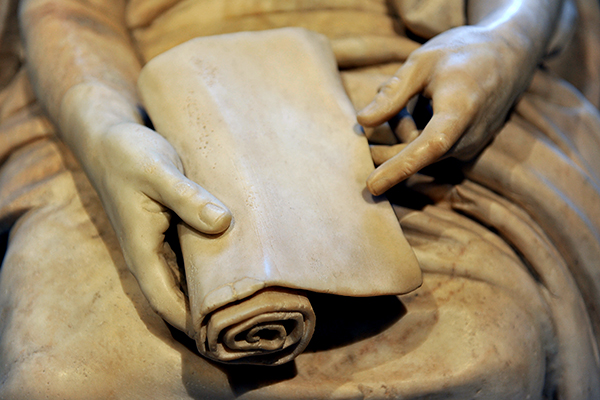
The detail of a scroll is from a statue in the Louvre, possibly of the Epicurean philosopher Metrodorus or an adaptation of a sitting Socrates.
The destruction of the Great Library of Alexandria and, even more so, its annex in the Temple of Serapis, are contentious topics and, for that reason, the primary sources have been cited in full.
References: Caesar: The Civil War Together with The Alexandrian War, The African War, and The Spanish War by Other Hands (1967) translated by Jane F. Gardner (Penguin Classics); Caesar: Civil Wars (1914) translated by A. G. Peskett (Loeb Classical Library); Caesar: Alexandrian War, African War, Spanish War (1955) translated by A. G. Way (Loeb Classical Library); Strabo: Geography (1917-) translated by H. L. Jones (Loeb Classical Library); Lucan: The Civil War (1928) translated by J. D. Duff (Loeb Classical Library); Florus: The Epitome of Roman History (1929) translated by E. S. Forster (Loeb Classical Library); Plutarch: Parallel Lives (1916-) translated by Bernadotte Perrin (Loeb Classical Library); Aulus Gellius: Noctes Atticae (1927) translated by J. C. Rolfe (Loeb Classical Library); Athenaeus: The Deipnosophistae (1927-) translated by Charles Burton Gluck (Loeb Classical Library); Suetonius: The Lives of the Caesars (1914) translated by John C. Rolfe (Loeb Classical Library); Epitome de Caesaribus (2009) translated by Thomas M. Banchich (this electronic text is the only translation in English); Zosimus: New History (1982) translated by Ronald T. Ridley; Ammianus Marcellinus: Roman History (Vol. II) (1940) translated by John C. Rolfe (Loeb Classical Library); Seven Books of History Against the Pagans: The Apology of Paulus Orosius (1936) translated by Irving Woodworth Raymond; Epiphanius' Treatise on Weights and Measures (1935) edited by James Elmer Dean; Philostratus and Eunapius: The Lives of the Sophists (1921) translated by Wilmer Cave Wright (Loeb Classical Library); The Chronicle of John of Nikiu (1916) translated by R. H. Charles; Appian: Roman History (Civil Wars) (1913) translated by Horace White (Loeb Classical Library); Historia Augusta (1921-) translated by David Magie (Loeb Classical Library); The Scholia on the Aves of Aristophanes (1914) edited by John Williams White; Philostratus: The Life of Apollonius of Tyana (1912) translated by F. C. Conybeare (Loeb Classical Library); Dio Chrysostom: Discourses (1940) translated by J. W. Cohoon and H. Lamar Crosby (Loeb Classical Library); The Works of Lucian of Samosata (1905) translated by H. W. and F. G. Fowler (Loeb Classical Library).
"Alexandria: Library of Dreams" (2002) by Roger S. Bagnall, Proceedings of the American Philosophical Society, 146(4), 348-362; Travelling Mathematics: The Fate of Diophantos' Arithemtic (2010) by Ad Meskens; What Happened to the Ancient Library of Alexandria? (2008) edited by Mostafa El-Abbadi and Omnia Mounir Fathallah; The Architecture of Alexandria and Egypt: 300 BC to AD 700 (2007) by Judith McKenzie; "Cloistered Bookworms in the Chicken-Coop of the Muses: The Ancient Library of Alexandria" by Robert Barnes, in The Library of Alexandria: Centre of Learning in the Ancient World (2000) edited by Roy Macleod; "From Romance to Rhetoric: The Alexandrian Library in Classical and Islamic Tradition" (1992) by Diana Delia, The American Historical Review, 97(5), 1449-1467; Ptolemaic Alexandria (1972) by P. M. Fraser; Ptolemaic Alexandria (1972) by P. M. Fraser; Kallimachos: The Alexandrian Library and the Origins of Bibliography (1991) by Rudolf Blum; The Vanished Library: A Wonder of the Ancient World (1990) by Luciano Canfora; "The Alexandrian Library and its Aftermath" (1999) by Uwe Jochum, Library History, 15, 5-12; "Tradition's Destruction: On the Library of Alexandria" (2002) by Daniel Heller-Roazen, Obsolescence, 100, 133-153; Libraries in the Ancient World (2001) by Lionel Casson; Arguments from Ignorance (1996) by Douglas Walton; Historians' Fallacies: Toward a Logic of Historical Thought (1970) by David Hackett Fischer; The Life and Fate of the Ancient Library of Alexandria (1990) by Mostafa El-Abbadi (a modest but succinct account published by UNESCO in anticipation of the new library at Alexandria); "The Great Library of Alexandria?" (2010) by Heather Phillips, Library Philosophy and Practice (August); Roman Circuses: Arenas for Chariot Racing (1986) by John H. Humphrey; History of Classical Scholarship: From the Beginnings to the End of the Hellenistic Age (1968) by Rudolph Pfeiffer; The Arab Conquest of Egypt and the Last Thirty Years of the Roman Dominion (1902) by Alfred J. Butler; "Ashes to Ashes? The Library of Alexandria after 48 BC" by Myrto Hatzimichali, in Ancient Libraries (2013) edited by Jason König, Katerina Oikonomopoulou, and Greg Woolf; "A New History of Libraries and Books in the Hellenistic Period" (2014) by S. Johnstone, Classical Antiquity, 33(2), 347-393. A good overview is "The Destruction of the Library of Alexandria: A Reassessment" (2017) by Christophe Rico, in The Library of Alexandria: A Cultural Crossroads of the Ancient World, edited by Christophe Rico and Anca Dan.
There also is the very satisfying Alexandria (2009) in the Marcus Didius Falco mystery series by Lindsey Davis as read by Christian Rodska.
See also Scroll and Codex, Hypatia.
