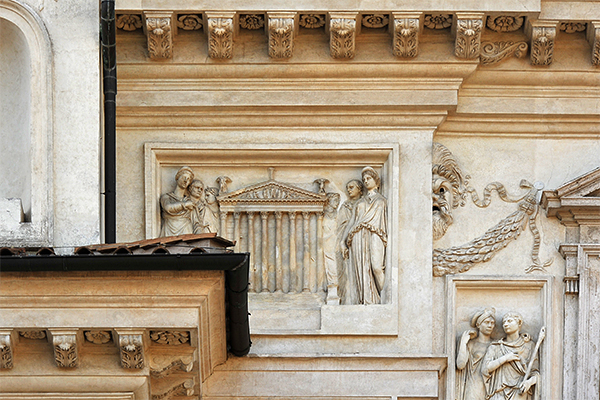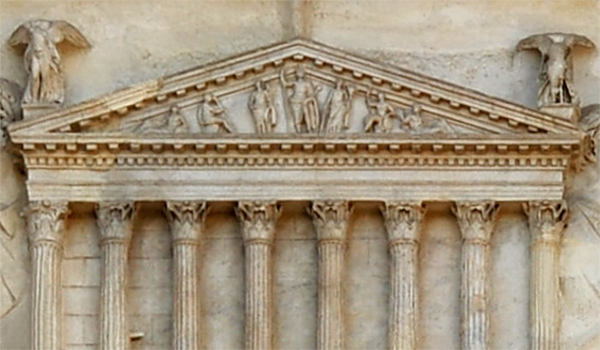
The pediment of the Temple of Mars Ultor can be seen in a fragment now embedded in the garden façade of the Villa Medici in Rome. Similar in style to the reliefs of the Ara Pacis Augustae, the large marble panel likely was part of a decorative scheme running across the architrave of the Arch of Claudius, which had been decreed upon his triumphal return from Britain in AD 43.
In the center of the tympanum (the area within the pediment) is Mars himself holding a lance, to whom Augustus had vowed the temple for the god's help in avenging Caesar's death. The father of Romulus, he is flanked on his right by Venus, the mother of Aeneas and founder of the Julian line, who is holding a scepter. Seated next to her is Romulus, founder of Rome, and, reclining in the corner, the personification of the Palatine Hill, where the city began and the imperial palace was situated. To the left of Mars is Fortuna, with her cornucopia and steering oar, who had ensured Augustus' success. She is accompanied by Roma, seated with her weapons, and the personification of the river Tiber. The ideology of this sculptural program is reinforced by the ornaments that decorated the pediment, itself. Coins show acroteria on the roof that include Augustus in his quadriga at the apex, and, at the corners, Romulus to his right and Aeneas to his left, both moving toward the emperor.
The fragment depicting the Temple of Mars Ultor is one of four large panels that together comprise two scenes, the iconography of which likely depicts a sacrifice to the divine Augustus that was part of a ceremony beginning on the Palatine Hill and ending at the Forum of Augustus.
Magnificently situated on the Pincian Hill, the villa was acquired by Cardinal Ferdinando de' Medici in January 1576. Less than a month later, he asked the architect and sculptor Bartolomeo Ammannati to come to Rome and advise him on renovating the property. A new galleria was proposed, as well as the construction of a loggia and a second tower to complement the existing one. By the summer of that year, Ammannati had returned to Florence, presumably leaving supervision of the work to someone else. In October 1577, the cardinal began negotiating the purchase of ancient sculpture that had been collected by Cardinal Andrea della Valle and his nephew Camillo Capranica. The plan for the garden façade was revised (although likely not by Ammannati) to accommodate these new treasures, which were moved to the villa in 1584, when they were ready to be installed.
References: Augustan Culture (1996) by Karl Galinsky; Ara Pacis (2006) by Orietta Rossini; The Museums of the Imperial Forums in Trajan's Market (2007) edited by Lucrezia Ungaro; "Ammannati and the Villa Medici in Rome: An Unknown Letter" (1975) by Edmund P. Pillsbury, Mitteilungen des Kunsthistorischen Institutes in Florenz, 19, 303-306; "The Villa Medici in Rome: The Projects of 1576" (1975) by Glenn M. Andres, Mitteilungen des Kunsthistorischen Institutes in Florenz, 19, 277-302 (whose two-volume The Villa Medici in Rome, 1976, is the standard text. Although this text is in English, the majority of work on the Villa Medici is in Italian).
See also French Academy and the Arch of Claudius.