"There have been two pearls that were the largest in the whole of history; both were owned by Cleopatra, the last of the Queens of Egypt—they had come down to her through the hands of the Kings of the East....In accordance with previous instructions the servants placed in front of her only a single vessel containing vinegar, the strong rough quality of which can melt pearls. She was at the moment wearing in her ears that remarkable and truly unique work of nature. Antony was full of curiosity to see what in the world she was going to do. She took one earring off and dropped the pearl in the vinegar, and when it was melted swallowed it....With this goes the story that, when that queen who had won on this important issue was captured, the second of this pair of pearls was cut in two pieces, so that half a helping of the jewel might be in each of the ears of Venus in the Pantheon at Rome."
Pliny, Natural History (IX.59.119-121; also Macrobius, Saturnalia, III.17.14-17)
Already treasured in the East, by the first century BC pearls had become fashionable in Rome, a craze that Pliny (XXXVII.12) says was introduced by the victory over Mithridates by Pompey, whose third triumph was celebrated in 61 BC and included, much to Pliny's disapprobation, a portrait of Pompey rendered in pearls. Indeed, Pliny criticizes all such ostentatious display, whether two or three pearls dangling from the ears of women so they could hear them rattle as they moved (IX.114) or the vulgar presentation by Lollia Paulina (IX.117), who was to become the third wife of Caligula. Once, at what was to have been a modest engagement party, Pliny actually met Lollia, who arrived wearing emeralds and pearls on her head, neck, ears, wrists, and fingers. They cost forty million sesterces and she carried the receipts to prove it.
There were other critics of such pretension. Seneca (On Benefits, VII.9) complains that the ears of women are trained to carry pearls in pairs, with another fastened above, and are not content unless the value of two or three estates hang from each lobe. Martial (Epigrams, VIII.81) chides a Roman matron who swears, not by the gods, but by her pearls, which she loves more than her own sons. And Tibullus (Elegies, II.4) bemoans his lover's greediness for emeralds and pearls.
Caesar was said to have invaded Britain for the fresh-water pearls to be found there and "in comparing their size he sometimes weighed them with his own hand" (Suetonius, XLVII). Tacitus is more disdainful and considers British pearls to have "a cloudy and livid hue" (Agricola XII.6; that having been said, the Abernethy Pearl, which was found in the River Tay in Scotland, is an exceptional freshwater specimen). He also attempted to restrict the wearing of pearls, a symbol of wealth and prestige, only "to those of a designated position and age, and on set days" (XLIII.1). In 46 BC, Caesar returned from Egypt to Rome, where he was joined by Cleopatra and their infant son. After his triumphs that year, he dedicated a cuirass made completely of British pearls in the Temple of Venus Genetrix (Pliny, IX.116). An appropriate symbol of the goddess, the breastplate was intended to recall (and surpass) Pompey's earlier display. In a position of honor next to the cult statue was placed a gilded statue of Cleopatra, herself (Dio, LI.22.3; Appian, The Civil Wars, II.102). Venus also was honored in the Pantheon, so named "because it received among the images which decorated it the statues of many gods, including Mars and Venus" (Dio, LI.22.2). It was this statue that received the second of Cleopatra's pearls, which would have been lost had not Lucius Munatius Plancus, who judged the wager, intervened. The one that was destroyed was said to have been worth ten million sesterces (a hundred thousand gold aurei or almost 1764 pounds of gold).
Pliny tells an earlier story about the profligate son of the actor Aesopus, who had inherited twenty million sesterces from his father and once dissolved a valuable pearl simply to discover its taste. When it proved "marvellously acceptable," pearls were given to each of his guests to do the same (IX.59.122). Horace recalls the incident in his Satires (II.3.239ff; as does Valerius Maximus, Memorable Doings and Sayings, IX.1.2). In this recounting, the scion impetuously took a pearl worth a million sesterces from the ear of the notorious Caecilia Metella Celer (with whom he had an affair) and dissolved it in vinegar. Horace wrote his satire about 33 BC, just about the time that Cleopatra's own demonstration had taken place (Plancus deserted Antony and left for Rome in 32 BC), and one wonders if she was familiar with it. Later, Caligula, too, was said to "drink pearls of great price dissolved in vinegar" (Suetonius, XXXVII.1).
Pausanias recounts that "pearls are dissolved by vinegar" (VIII.18.6), a word that derives from the Latin vinum (wine) and acer (sour). Mostly calcium carbonate, they are indeed susceptible to a weak acid solution. Wine, if it still is to be drinkable, is not more than 0.1% acetic acid and not sufficiently acidic to dissolve a pearl, at least not quickly enough to have impressed Antony. Wine vinegar, on the other hand, is approximately 5-7% acetic acid, a concentration necessary if the calcium carbonate is to be dissolved. Egyptian vinegar was stronger still—and even worse, says Martial, when it was wine (Epigrams, CXXII). The crystals of calcium carbonate are converted by acetic acid into calcium acetate, which dissolves in the residual water, and carbonate that effervesces as bubbles of carbon dioxide, the formula for which is CaCO3 + 2CH3COOH —> Ca(CH3COO2) + H2O + CO2.
How Cleopatra could manage to drink her vinegar-and-pearl concoction can be explained by the acid-base reaction that takes place, the acid being neutralized by the calcium carbonate, much like an antacid. Intriguingly, there is a name for the residue obtained from the precipitate of an acid solution—magistery. Cleopatra’s magistery of pearl, offered in toast to Antony, was thought to be an aphrodisiac, probably because pearls were associated with Venus and both were born of the ocean.
Certainly the story has seduced later readers.

Cleopatra's Banquet by Gerard Lairesse (1680), which is in the Rijksmuseum (Amsterdam), is one of many depictions of Cleopatra's wager. Here, Lucius Plancus stops the queen before she can dissolve her second earring.
In The Deipnosophists, Athenaeus (IV.147-148) quotes a lost account of banqueting between Antony and Cleopatra.
"Meeting Antony in Cilicia, Cleopatra arranged in his honour a royal symposium, in which the service was entirely of gold and jewelled vessels made with exquisite art; even the walls...were hung with tapestries made of purple and gold threads. And having spread twelve triclinia, Cleopatra invited Antony and his chosen friends. He was overwhelmed with the richness of the display: but she quietly smiled and said that all these things were a present for him; she also invited him to come and dine with her again on the morrow, with his friends and his officers. On this occasion she provided an even more sumptuous symposium by far; so that she caused the vessels which had been used on the first occasion to appear paltry; and once more she presented him with these also. As for the officers, each was allowed to take away the couch on which he had reclined; even the sideboards, as well as the spreads for the couches, were divided among them. And when they departed, she furnished litters for the guests of high rank, with bearers, while for the larger number she provided horses gaily caparisoned with silver-plated harness, and for all she sent along Aethiopian slaves to carry the torches. On the fourth day she distributed fees, amounting to a talent, for the purchase of roses, and the floors of the dining-rooms were strewn with them to the depth of a cubit, in net-like festoons spread over all."
Plutarch, too, has something to say about such extravagance in his Life of Antony (XXVIII.3-4).
"Accordingly, he [a physician at Alexandria who relates the story] was introduced into the kitchen, and when he saw all the other provisions in great abundance, and eight wild boars a-roasting, he expressed his amazement at what must be the number of guests. But the cook burst out laughing and said: 'The guests are not many, only about twelve; but everything that is set before them must be at perfection, and this an instant of time reduces. For it might happen that Antony would ask for supper immediately, and after a little while, perhaps, would postpone it and call for a cup of wine, or engage in conversation with some one. Wherefore,' he said, 'not one, but many suppers are arranged; for the precise time is hard to hit.'"
Pearls are created when an irritant, trapped in the fleshy mantle of a mollusk such as a pearl oyster or fresh-water mussel, becomes coated with the same nacre or mother-of-pearl that lines the shell, itself. This nacreous secretion is composed of alternating layers of aragonite (a crystalline form of calcium carbonate) and conchiolin (an organic protein that binds the crystals together). It is the concentric layers of translucent aragonite that both reflect light to give a pearl its luster, and refract or disperse light to produce its shimmering iridescence or orient. A pearl is approximately 85-90% calcium carbonate; the remainder, conchiolin and a small percentage of water. Although not very hard, pearls are strong, and their composition and shape make them difficult to break. For a pearl to be readily soluble in vinegar, it likely would have to be crushed. Or, given the time involved in dissolving a large pearl, powdered or not, it may have been more efficacious simply to swallow it whole. As it no doubt could be recovered later, it certainly would be more economical.
"The king shall drink to Hamlet's better breath;
And in the cup an union shall be thrown,
Richer than that which four successive kings
In Denmark's crown have worn."Shakespeare, Hamlet (V.2)
Here, "union" derives from the Latin unio, the name given to pearls of exceptional size (Pliny, IX.59.123) or, as Philemon Holland translated the passage in 1601 (about the same time that Hamlet was written), "the faire and goodly great Pearles began to be named Uniones." (It would be two and a half centuries before there was another translation of Pliny into English, by John Bostock in 1855, and then almost a century more before the Loeb edition of 1938.)
Earlier, Holland says of pearls that
"Their chiefe reputation consisteth in these two properties, namely, if they be orient white, great, round, smooth, and weightie. Qualities, I may tell you, not easily to be found all in one: insomuch as it is impossible to find two perfectly sorted togither in all these points. And hereupon it is, that our dainties and delicates here at Rome, have devised this name for them, and call them Uniones; as a man would say, Singular, and by themselves alone" (IX.35).
Unio also is the source for "onion" because of its single bulb (compared to garlic or shallot, for example) and its fancied resemblance to a large pearl. Indeed, the pearl onion in a Gibson martini is a fitting reminder of Cleopatra's wager.
In The History of Banking (1850) William John Lawson recounts an earlier story (1726) about an equally extravagant meal hosted by Sir Thomas Gresham, founder of the Royal Exchange and after whom Gresham's Law is named ("Bad money drives out good"). During the reign of Elizabeth I (in 1560, the year that Gresham established the pound sterling), he purportedly took a large pearl from the East Indies which he valued at £15,000 and crushed it before the Spanish ambassador. Then, toasting the health of his Queen, he drank the powder in a glass of wine.
References: Pearls: A Natural History (2001) by Neil H. Landman, Paula M. Mikkelsen, Rüdiger Bieler, and Bennet Bronson; The Book of the Pearl (1908) by George Frederick Kunz and Charles Hugh Stevenson; "Cleopatra's Pearls" (1957) by Berthold L. Ullman, The Classical Journal, 52(5), 193-201; "Pearls for Venus" (1988) by Marleen B. Flory, Historia: Zeitschrift für Alte Geschichte, 37(4), 498-504; "Cleopatra's Cocktail" (2010) by Prudence J. Jones, Classical World, 103(2), 207-220.
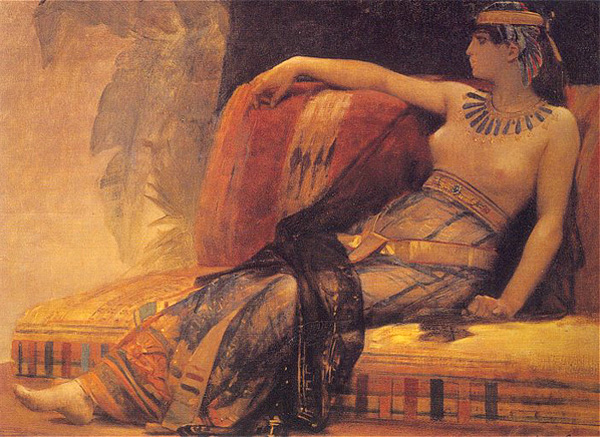
The picture (top) is by Alexandre Cabanel and is a study for Cleopatra Testing Poisons on Condemned Prisoners (1887).
See also Ecole des Beaux-Arts and Temple of Venus Genetrix. Caesar originally had vowed a temple to Venus Victrix, but Pompey's own temple to the goddess, dedicated in 55 BC (Pliny, VIII.20; Aulus Gellius, X.1.7), obliged him to consecrate it to Venus Genetrix instead. (To avoid censure for the construction of a permanent theater in Rome, Pompey supposedly had the temple built at the top of the tiered rows of the cavea so that they would seem to be the steps leading to the temple and not seating for the spectators.)
