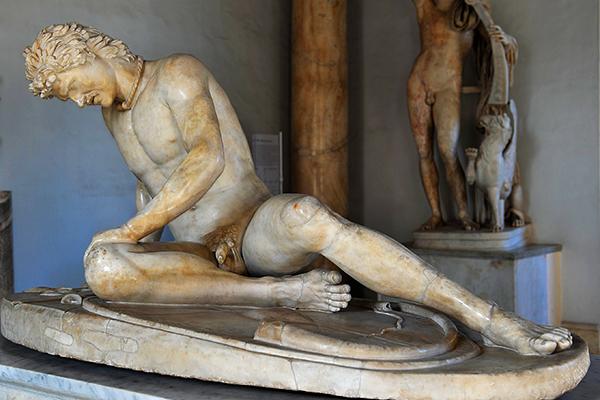
This statue is from Pergamon, the royal capital of the Attalids on the coast of present-day Turkey. In 278 BC, migrating Celtic tribes from Gaul crossed the Hellespont and settled in Galatia to the east. In a series of campaigns fought some fifty years later, they were defeated by Attalus I in defense of the Greek cities of the region. The statue likely is a second-century AD Roman copy of a third-century BC Hellenistic bronze commemorating that victory. It has been associated with the sculptor Epigonus, to whom Pliny attributes the "Trumpeter" (a curved Celtic trumpet rests at the feet of the dying warrior) and whose name is inscribed on the base of one of the great victory monuments erected on the acropolis at Pergamon around 220 BC.
Another statue, probably from that same monument, is the Ludovisi Group, which shows a Gallic chieftain, who already has slain his wife and now, rather than be captured, defiantly turns his sword upon himself. The respect of the Greeks for their defeated foe is evident in these heroic representations, as is the implicit prowess of the victors over them.
Part of the 1623 inventory of the Ludovisi collection and acquired by Clement XII in 1737, the statue was extensively restored in the seventeenth century. Three fragments of the left leg below the knee were reassembled (the pin that attaches the calf to the upper leg is concealed by the kneecap). The right arm (and the section of the base on which it rests) has been reconstructed, as well, and originally may have been slightly longer and nearer the body. The spiky hair is a reworking of longer locks that had broken off and been reshaped. Finally, the marble was polished.
Reference: History of Restoration of Ancient Stone Sculptures (2001) edited by Janet Burnett Grossman, Jerry Podany, and Marion True.
See also the restoration of a panel depicting Marcus Aurelius.
