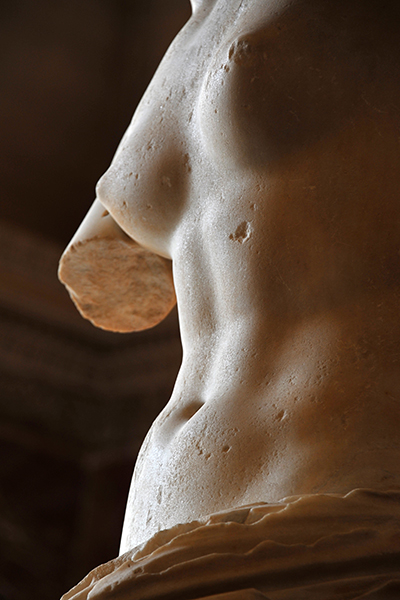
"The arts which are dependent on drawing have, like all inventions, commenced with the necessary; the next object of research was beauty; and, finally, the superfluous followed: these are the three principal stages in art."
Johann Winckelmann, The History of Ancient Art (I.1.1)
The Venus de Milo was discovered on April 8, 1820 on the small Aegean island of Melos, then a backwater under the indifferent rule of the Ottoman Turks but subject politically to the influence of France. Olivier Voutier, an ensign in the French navy, whose warship had been idling in port, was searching for Greek antiquities when a local farmer working nearby uncovered the statue while removing stones from a niche in an ancient wall. It was found in several pieces—a nude upper torso, a draped lower body, and part of the right hip that, when put in place, allowed the other two parts to fit together without toppling over. The arms were missing but Voutier was convinced that the sculpture was a masterpiece and hurriedly returned with the local vice-consul to persuade him to buy it. Meanwhile, the farmer had continued to dig and found a hand holding an apple, two herms on inscribed bases, the chignon (where the hair was knotted at the back of the head), and a fragment of an upper arm.
A week or so later, another French ship arrived at Melos with another ensign, Dumont d'Urville, who was looking for botanical specimens. Introducing himself to the vice-consul and taken to see the statue, d'Urville was as excited at the discovery as Voutier had been, but neither man was in a position to buy the Venus. They had not the permission or the means. Nor was there room on board the ships, which continued their journey to Constantinople. D'Urville arrived first, where he met the Comte de Marcellus, secretary to the Marquis de Rivière, the French ambassador. Hearing his story of the recent discovery, Marcellus, who himself was soon to leave on a tour of the Mediterranean, convinced the ambassador that he first should stop at Melos and buy the statue on behalf of Rivière who, he suggested, then could present it to the king. By now, Voutier's ship also had arrived, which was tasked with transporting Marcellus on his diplomatic mission.
Just as the ship docked at Melos on May 22, Marcellus and Voutier discovered that, even though the French had made the initial offer, the statue had been sold to a representative of the provincial pasha and was being loaded on board for shipment to Constantinople. Marcellus intervened, first threatening local officials for breaking their agreement with the vice-consul and then paying them 250 francs, and the farmer another 750. The statue would go to Constantinople but to Rivière, who then accompanied it to Paris in triumph. The local officials on Melos, who had been fined by the Turks for not holding the statue, were reimbursed by Rivière and they, in turn, signed a quittance. It is this agreement that has spared the Venus de Milo from later claims of patrimony.
The Venus was presented to Louis XVIII almost a year later on March 1, 1821, although the king was so obese that it would be another year before he actually saw it. Placed in the Louvre, its restoration was to be supervised by the Comte de Forbin. He had become director in 1816, the same year that the British parliament voted to purchase the Parthenon sculptures acquired by Lord Elgin. (The year before, after the defeat of Napoleon at Waterloo, the Apollo Belvedere had been returned to the Vatican and the Venus de' Medici to Florence. For the pride of France, the Venus de Milo had to rival these new acquisitions by the British Museum and compensate for those works of art removed from the Louvre.)
By now, d'Urville was back in France and presented a paper in which he himself took credit for having discovered the statue. It was the first published report of the Venus and obliged Forbin to make his own announcement, which he did several months later. But there were problems. The statue comprised two blocks of marble that had been joined at the hip. The left arm and foot also were fashioned as separate pieces and fixed in place with tenons. Aside from the fragment of the right hip, three other pieces had broken away in shipment—another from the right hip and two from the left, all of which had been damaged (and repaired) sometime after the statue was sculpted.
More problematic was the broken base of one of the herms that had been found with the statue. It fit perfectly with the fractured base of the Venus itself, which meant that both were part of the same marble slab. Equally disconcerting to Forbin, the base of the herm was inscribed in Greek <Alex>andros son of <M>enides citizen of <Ant>ioch at Meander made <it>. Antioch had not been founded until about 280 BC, a hundred years after the classical age in Greece had ended. Instead of a presumed masterpiece by the hand of Phidias or Praxiteles, the Venus de Milo was, in fact, a late Hellenistic creation and so, according to Winckelmann's theory of the cycles of art, a devalued and superfluous example from a period in decline.
So incongruous did it seem to Forbin that these two pieces should belong together (and so inconvenient the date if they did) that the inscribed portion of the base was thought to have been fitted to the statue sometime later. And, since the fragment obviously did not belong to the Venus, it need not be displayed. The base of the herm later disappeared and has not been found. Were it not for Forbin's former art teacher, the neoclassic painter Jacques-Louis David, its existence likely would never even have been known. But, having read a notice of the acquisition, David had written another student of his (and classmate of Forbin) at the Louvre, asking that a drawing of the statue be made.
All that now remained was an authoritative declaration that the Venus was a product of the classical age. It came six weeks later from Quatremère de Quincy, secretary of the Académie des Beaux-Arts, who pronounced the statue to be from the school of Praxiteles himself. He also argued that the arms should not be restored, if only because a statue of Mars, which he believed had been paired with the Venus, could not be recreated as well. In May 1821, the Venus de Milo finally was put on public display, which, now that it could be studied more closely, prompted a response from the Comte de Clarac, conservator of antiquities at the Louvre, who, having been studiously ignored by Forbin and upset that Quatremère had presumed to comment on the authenticity of the Venus, insisted that it had been executed by Alexandros of Antioch—as proclaimed on the inscribed base. And gracing the cover of his pamphlet was the drawing that David had requested earlier.
Clarac's paper largely was ignored by the French but not by the Germans, who felt that they were the rightful owners of the statue. Several years before, Crown Prince Ludwig I of Bavaria (who commissioned the Glyptothek in Munich) had purchased the nearby ruins of an ancient theater on Melos and now insisted that the statue had been found on his land. The debate between French and German scholars effectively ended in 1893, when Adolf Furtwängler published Meisterwerke der Griechischen Plastik. Based on the epigraphy of the inscription, he dated the statue to the late Hellenistic period, between 150 and 50 BC. An inscription from Thespiae in Boeotia, where poetry and theater competitions were held every five years, mentions an Alexandros of Antioch as victor in singing and composing and, if the same person, narrowed the date to about 150–100 BC. (Maggidis posits 150–110 BC; the Louvre says "about 120 BC.")
The Venus had been found in a niche in the wall of the civic gymnasium, where an inscription over the entrance indicated that the assistant gymnasiarch had dedicated "this exedra and this <statue> to Hermes and Hercules," its two patrons. (This stone, too, has disappeared from the Louvre but not before d'Urville and Clarac had copied the inscription.) Voutier's drawing of the Venus at the time of discovery shows that it was placed next to the Hercules on the same plinth, the left arm extending away from the body and, as there is no evidence of a strut, supported by the herm. The right reached across the stomach, pulling at the gathered drapery that, slipping from the hips, is held in place by the raised left leg.
In the fragmentary left hand, there is the apple that was awarded to Venus in the Judgment of Paris
(Cypria, I; Ovid,
Heroides, XVI.51ff). It is a particularly appropriate gesture. An
attribute of Venus, it also alludes to the island, itself, which was in the
shape of an apple (melon), hence its name and that of the statue, itself (de Milo). The prize
of the apple may have reminded those
who gazed upon the Venus why she had defeated her rivals Hera and Athena (in spite of their bribes) and what choices the young gymnasts,
themselves, eventually would have to make: whether political power, military success,
or love.
The Comte de Forbin (whose daughter, incidentally, married the Comte de Marcellus) had an affair with Pauline, the impulsive and flirtatious younger sister of Napoleon and openly lived with her, until in 1807 she tired of him. Sent off to the army, Forbin fought so bravely that he was awarded the Legion of Honor. There also was a long flirtation with the salonnière Madame Récamier. The beauty of both women still is on display: Canova's marble statue of Pauline in the Galleria Borghese (Rome), reclining nude and holding an apple as Venus Victrix; and the painting of Madame Récamier by David in the Louvre. Unhappy with the severe neoclassicism of the still unfinished portrait, she commissioned his student François Gérard to paint her in a more flattering pose. Piqued, David let the picture remain in his studio. Dumont d'Urville, who gained renown as an explorer, is mentioned by Jules Verne in 20,000 League under the Sea (I.18).
In 1854, John Murray still could describe Melos in A Handbook for Travelers in Greece as "almost depopulated, and nearly a desert; a result that is to be ascribed to the ravages of the plague in former times, to the badness of the water, which is generally brackish, to the prevalence of malaria, and to the many outrages and exactions to which the island was exposed under the Turkish rule."
In the sixteenth year of the Peloponnesian War (416 BC), Athens sent an expeditionary force to Melos, which, although a colony of Sparta, had tried to remain neutral. In the Melian Dialogue, Thucydides dramatizes the arrogance of the Athenians (who themselves would suffer the next year in the disastrous Sicilian campaign) and the sophistry of their contention "that right, as the world goes, is only in question between equals in power, while the strong do what they can and the weak suffer what they must" and that "Of the gods we believe, and of men we know, that by a necessary law of their nature they rule whenever they can." When the inhabitants of Melos rejected these specious arguments, trusting in fortune to defend their liberty, they were defeated and forced to surrender to the Athenians, "who put to death all the grown men whom they took, and sold the women and children for slaves, and subsequently sent out five hundred colonists and inhabited the place themselves" (The Peloponnesian War, XVII, trans. Crawley).
References: Disarmed: The Story of the Venus de Milo (2003) by Gregory Curtis; "Creating the Past: The Vénus de Milo and the Hellenistic Reception of Classical Greece" (2005) by Rachel Kousser, American Journal of Archaeology, 109(2), 227-250; "The Aphrodite and the Poseidon of Melos" (1998) by Christofilis Maggidis, Acta Archaeologica, 69, 175-197; "Base Deception" (2003, October) by Gregory Curtis, Smithsonian Magazine, 101-107; Masterpieces of Greek Sculpture (1895) by Adolf Furtwängler and edited by Eugénie Sellers; The Venus of Milo: An Archeological Study of the Goddess of Womanhood (1916) by Paul Carus.
