Isidore of Seville on the Roman Circus
The following paragraphs have been taken from The Etymologies of Isidore of Seville (2006) translated by Stephen A. Barney, W. J. Lewis, J. A. Beach, and Oliver Berghof (Cambridge University Press), which is available online as a PDF:
XVII.xxvii. Circus games (De ludis circensibus) 1. The circus games were established for the sake of sacred rites and celebrations of the pagan gods; hence, those who watch them are seen to be devoted to demons’ cults. Formerly, simple equestrian events were performed, and the common custom was not at all deserving of censure, but when this natural practice developed into public games it was converted into the worship of demons. 2. And so this kind of competition was dedicated to Castor and Pollux, to whom, the stories teach us, horses were granted by Mercury. Neptune also is a god of the equestrian game, and the Greeks call him ϊππιος (cf. ϊππιος, “horse”); horses in the games are also consecrated to both Mars and Jupiter, and it is they who preside over the four-horse chariots. 3. The circus (circensis) games are so called either from ‘going in a circle’ (circumire), or because, where the turning-posts are now, formerly swords were set up which the chariots would go around–and hence they were called circenses games after the ‘swords around’ (ensis + circa) which they would run. And indeed, those driving chariots on the shore along the banks of rivers would set up swords in a row at the riverbank, and part of the art of horsemanship was to wheel around these dangerous obstacles. From this the circenses games are thought to have been named, as if the terwere ‘around swords’ (circum enses).
xxviii. The circus (De circo) 1. The circus was chiefly dedicated by the pagans to the sun god, whose shrine was in the middle of the racetrack and whose effigy shone out from the gable of the shrine, because they did not think that he, whom they believed was in the open, ought to be worshipped under a roof. A circus is the whole space that horses would race around. 2. The Romans think that it was called circus from the ‘circuit’ (circuitus) of horses, because there the horses race around (circum) the turning-posts. But the Greeks say it was named after Circe, daughter of the sun god, who founded this kind of competition in honor of her father, and from her name they argue that the term circus derived. Moreover, she was a sorceress and a witch and a priestess of demons; in her conduct we may recognize both the working of the magical arts and the cult of idolatry.
xxix. The apparatus (De ornamentis) 1. The apparatus of the circus comprises the ‘eggs,’ the turning posts, the obelisk, and the starting-gate. Some people say the ‘eggs’ (i.e. objects used to mark the number of circuits of the chariots) are in honor of Pollux and Castor; these same people do not blush to believe that these two were begotten from an egg sired by Jupiter as a swan. 2. The Romans claim that the circus games represent the first principles of the world, so that under this pretext they may excuse the superstitions of their own empty beliefs.
xxx. The turning-posts (De metis) Properly by the term ‘turning-posts’ (meta) people mean to designate the end-point and boundary of the world, from the fact that the end is ‘measured out’ (emetiri) in some way, or as a token of the rising and setting of the sun.
xxxi. The obelisk (De obelisco) 1. Mesfres, king of Egypt, is said to have been the first to make an obelisk, for the following reason. Because the Nile once had damaged Egypt with a violent flood, the indignant king, as if to exact a penalty from the river, shot an arrow into the water. Not long afterwards, seized by a serious illness, he lost his sight, and once his vision was restored after this blindness he consecrated two obelisks to the sun god. ‘Obelisk’ (obeliscus) is the name of the arrow that is setup in the middle of the circus because the sun runs through the middle of the world. 2. Moreover, the obelisk, set up in the midpoint of the space of the racetrack equidistant from the two turning-posts, represents the peak and summit of heaven, since the sun moves across it at the midpoint of the hours, equidistant from either end of its course. Set on top of the obelisk is a gilded object shaped like a flame, for the sun has an abundance of heat and fire within it.
xxxii. The starting-gates (De carceribus) In the circus the places from which the horses are loosed are called starting-gates (carcer), for the same reason that prisons (carcer) in a city are so named–because, just as humans are condemned and imprisoned there, so horses are ‘confined’ (coercere) here so that they may not start off before the signal is given.
xxxiii. Charioteers (De aurigis) 1. The art of the circus comprises the charioteer and the race, people on horseback or on foot. The charioteer (auriga) is properly so called because he ‘drives and guides’ (agere et regere), or because he ‘beats’ (ferire) the yoked horses, for one who ‘gouges’ (aurire) is one who ‘beats’ (ferire), as (Vergil, Aen. 10.314):
He gouges (aurire, i.e. haurire, lit. “drink”) the open side.
2. A charioteer is also a driver (agitator), that is, a whipper, so called from ‘driving’ (agere). Further, charioteers wear two colors, with which they make a display of their idolatry, for the pagans dedicated the green to the earth and the blue to the sky and sea.
xxxiv. The team of four (De quadrigis) 1. Ericthonius, who ruled Athens, is said to have been the first to yoke together four horses, for which Vergil is the authority, saying (Geo. 3.113):
Ericthonius first dared to yoke a chariot and four horses, and to stand as victor on swift wheels.
2. He was, as the legends say, the son of Minerva and Vulcan, born from the evidence of Vulcan’s lust spilled on the earth, as a demonic portent, or rather as a devil himself. He first dedicated the chariot to Juno. From such a founder were ‘four-horse chariots’ (quadriga) invented.
xxxv. The chariot (De curru) 1. The chariot (currus) takes its name from ‘racing’ (cursus), or because it is seen to have [many] wheels–thence also a ‘two-wheeled wagon’ (carrus), as if it were currus. The quadriga (i.e. a chariot with a team of four) formerly had a double and unbroken tongue, which linked all the horses with a single yoke. 2. Cleisthenes of Sicyon was first to yoke only the middle pair of horses, and to connect to them the other two on each side with a single band. These outer two the Greeks call σειραφόροι and the Latins call ‘trace-horses’ (funarius), from the kind of band (cf. funis, “rope”) with which they were formely linked.
xxxvi. The horses with which we race (De equis quibus currimus) 1. The quadriga, biga, triga, and seiuga (i.e. four-, two-, three-, and six-horse chariots) are named from the number of horses and the word ‘yoke’ (iugum). The quadriga is dedicated to the sun, the biga to the moon, the triga to the underworld, the seiuga to Jupiter, and the horse-vaulters (desultor) to Lucifer and Hesperus. They associate the quadriga with the sun because the year rolls through four seasons: spring, summer, autumn, and winter. 2. The biga with the moon, because it travels on a twin course with the sun, or because it is visible both by day and by night–for they yoke together one black horse and one white. The triga is consecrated to the infernal gods because they draw people to themselves in each of three ages– that is, infancy, youth, and old age. The seiuga, the largest chariot, races for Jupiter, because they think him the greatest of their gods. 3. Furthermore, they say that chariots race on wheels (rota) either because the world whirls by with the speed of its circle, or because of the sun, which wheels (rotare) in a circular orbit, as Ennius says (Annals 558):
Thence the shining wheel (rota) cleared the sky with its rays.
xxxvii. The seven laps (De septem spatiis) Chariots run seven laps (spatium), with reference to the courses of the seven planets by which they say the world is controlled, or to the course of the seven stages of life; when these stages have been completed, the end of life is reached. The end of these laps is the goal line (creta), that is, judgment (cf. cernere, ppl. cretus, “decide, judge”).
xxxviii. The riders (De equitibus) They say the riders (eques) race alone because each person traverses and completes the course of this life alone, one following another at different times, but through one path of mortality up to its own turning-post of death.
xxxix. Horse-vaulters (De desultoribus) Horsevaulters (desultores) are so called because formerly as each one came to the end of the course he would ‘leap down’ (desilire) and run, or because he would ‘vault across’ (transilire) from one horse to another.
xl. Foot racers (De peditibus) People speak of ‘foot racers’ (pedes) since they run on foot (pes, gen. pedis), because one makes a footrace toward one’s death. Because of this they run from the higher side to the lower, that is, from the direction of sunrise to sunset, because mortals rise up and then fall. They race naked because in a similar way no remains survive for a person in this world. They run a straight course because there is no distance between life and death. But they contrive these explanations in their effort to excuse their empty beliefs and sacrilege.
xli. The colors worn by horses (De coloribus equorum) 1. The pagans also associate, in a similar way, the colors decking the horses with the first principles of the elements, linking red with the sun, that is, with fire, white with air, green with earth, and blue with water. According to them, the reds race for summer, because it is the fiery color, and everything turns gold then. The whites for winter, because it is icy, and everything turns white in the cold. The greens for spring, from its green color, because then the young shoots grow thick. 2. Again, they dedicate those racing in red to Mars, from whom the Romans descend, and because the standards of the Romans are embellished with scarlet, or because Mars delights in blood. Those in white are dedicated to the zephyrs and mild weather; the greens to flowers and the earth; the blues to water or air, because they are of sky-blue color; the saffrons or yellows to fire and the sun; the purples to Iris, whom we call the rainbow, because it has many colors. 3. Thus, since in this spectacle they pollute themselves with the cult of their gods and with the cosmic elements, they are most certainly known to worship those same gods and elements. Hence, Christian, you should pay attention to the fact that unclean divinities possess the circus. For this reason that place, which many of Satan’s spirits have haunted, will be alien to you, for the devil and his angels have entirely filled it.
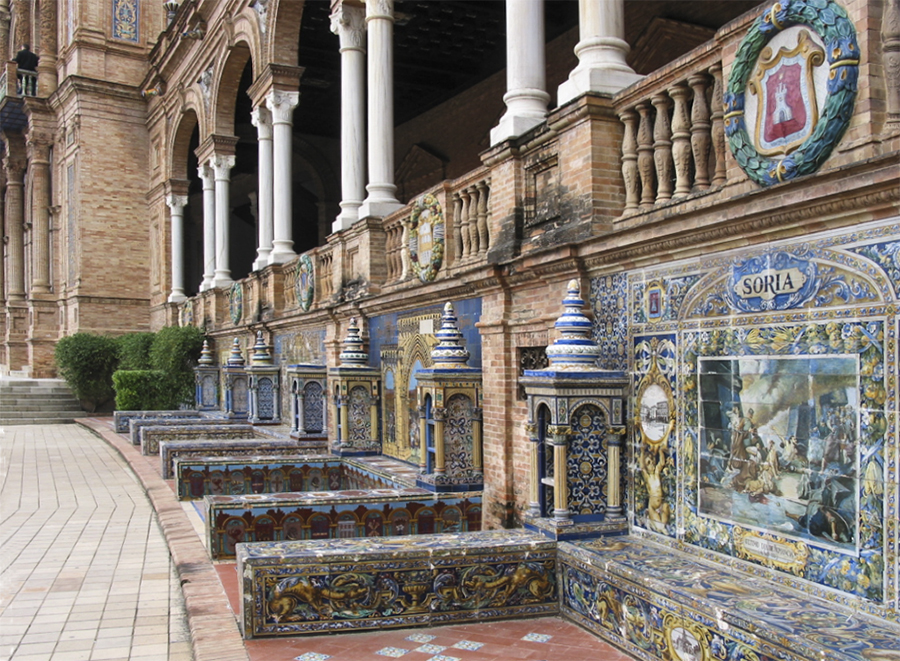
The photograph is of the Plaza de España in Seville. Each of Spain's 48 provinces that existed at the time of construction in 1929 are represented in a series of alcoves decorated with vivid ceramic tiles. Soria is shown because it was there that the Siege of Numantia took place in 133 BC.
See also The Celtiberian War.
