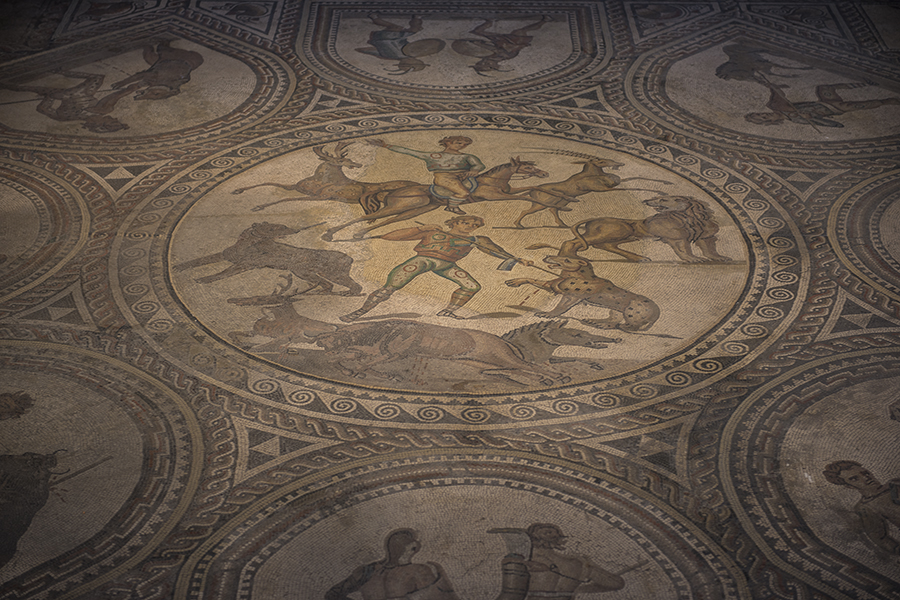
Some of the most vivid depictions of gladiatorial and animal contests are to be found on the edge of empire—in Germania Superior. One is outside the present-day spa town of Bad Kreuznach. Originally a Celtic settlement on the River Nahe, in the first-century BC it became a Roman vicus or village. Three centuries later, a sumptuous villa was constructed there, its mosaic floors masterpieces of the art.
Displayed in what likely was the dining room (triclinium) of the villa, one can read in the bottom left of the Oceanus Mosaic victorinvs·tess<ellarius>·fec<it> ("Victorinus, mosaicist, made this"). Another inscription, obscured in the shadows of the right-hand corner, reads maximo·et·v<rbano consulibus>, which dates the mosaic to AD 234, when Maximus and Urbanus held the Roman consulship.
Oceanus himself, hidden behind the fountain in the apse, is shown with crab claws sprouting from his forehead to signify the god's dominion over the sea and its creatures.
"About the panthers, the business is being carefully attended to according to my orders with the aid of those who hunt them regularly; but it is surprising how few panthers there are; and they tell me that those there are bitterly complain that in my province [Cilicia, on the eastern coast of Turkey] no snares are set for any living creature but themselves; and so they have decided, it is said, to emigrate from this province into Caria [farther west along the coast]."
Cicero, Letters to Friends (II.xi)
More elaborate still is the Gladiator Mosaic, which depicts a day at the gladiatorial games or munera (from the Latin for "gifts" or "offerings"). They began in the morning with the venatio ("hunt"). Here, a professional venator, wearing leg wrappings and protection for the extended left arm, holds a hunting spear (hasta or venabulum, literally "a thing for hunting") in both hands. He has just impaled a charging leopard—the exotic animal symbolic of the emperor's far-reaching power over nature. Other mosaics in the series show the deaths of local bulls, bears, and boars.
"Each new day gives us at morn conflicts more great. How many massive beasts, heavier than Nemea's monster [the Nemean lion, killed by Hercules as his first labor], are laid low! How many Maenalian boars [Hercules' fourth labor] does thy spear expose in death!"
Martial, Epigrams (V.65)
Dating to the late first-century AD, this beautifully preserved fresco shows a venator confronting a black-maned Barbary lioness, the painted detail much finer than the tessellae of a mosaic. It once adorned the podium of the amphitheater at Augusta Emerita (Mérida, Spain), where it is in the National Museum of Roman Art. Notice the small crossbar just behind the spear head, which prevented it from penetrating too deeply into the animal—and either getting stuck there or allowing the enraged beast to drive itself back up the shaft. Coincidentally, the "first physical evidence for human-animal gladiatorial combat from the Roman period seen anywhere in Europe" was published in 2025. A skeleton was found in a cemetery outside Eboracum (York, England) showing evidence of bite marks by a big cat, most likely a lion—the only remains to have been discovered with such injuries.
"...after military standards had first entered, two horsemen would come out, one from the east side and the other from the west, on white horses, bearing small gilded helmets and light weapons. In this way, with fierce perseverance, they would bravely enter combat, fighting until one of them should spring forward upon the death of the other, so that the one who fell would have defeat, the one who slew, glory."
Isidore of Seville, Etymologies (XVIII.liii)
After the venationes, there was gladiatorial combat, which was introduced in the afternoon by the eques. Although the word means "horseman," the combatants usually are depicted in the final, decisive stage of their dual—fighting on foot, after having dismounted and discarded their lances. He can be distinguished by a loose-fitting belted tunic and a plain brimmed helmet (galea) decorated by feathers fitted into sockets on either side, a medium-sized round shield (in imitation of the cavalry) and a short, straight sword. The right arm was protect by a manica ("sleeve") of thick quilting or leather, and the legs by short gaiters or wrappings. Because the eques always fought against his own kind (the only category of gladiator, other than the provocator, to do so), the tunics were of different colors so spectators could tell them apart.
Named after the Thracians, a barbarian tribe encountered by the Romans in its war against Mithridates VI, a thraex lunges at his opponent, having thrown aside his shield. Like the Illyrians and Dacians (whose homeland was the Balkan Peninsula), he carries a sica, a short sword native to the region that angled upward, allowed a strike around a shield to the exposed side. Given the small size of his own square shield (parmula), the thraex protected his sword arm and shoulder with a manica, the exposed legs by high greaves (ocreae) that reached almost to mid-thigh, and quilted padding (fasciae) up to the hips. A heavy leather belt (balteus) worn above the loincloth (subligaculum), offered some protection to the bare torso. Characteristically, the brimmed helmet was surmounted by the figure of a griffin, the companion of Nemesis, goddess of fate and judgment. Intriguingly, this thraex is left-handed (scaevus), a rarity that offered an advantage when confronting a gladiator who had been trained to fight right-handed and so carried his shield on the left—completely exposing the right side. Another curiosity is that the contest seems to be sine missione ("without reprieve") and ad mortem ("to death"). Hosting the games was an expensive proposition: a skilled gladiator had to be trained and maintained—and if one were killed, the sponsor (usually the emperor) had to pay full price for the loss.
Traditionally (and most frequently in the first-century AD), the thraex was paired against the murmillo. Named after the Latin murmuros (the striped sea bream, which has a prominent dorsal fin), the brimmed helmet of the murmillo was distinguished by its deep visor and high angular crest. Like the thraex, he wore a loincloth and belt, and protection for his right arm. But he also carried (like the legionary) a curved rectangular shield (scutum). Crouched behind it, he was protected virtually from chin to shin. The left leg was positioned forward in combat and what was not covered by the large shield was wrapped in padding behind a single short greave. The weapon of the murmillo was the gladius, a sword of medium length with a broad straight blade that, like the shield, was standard legionary issue. In this contest, one appreciates (as did the Romans themselves) the strengths of each combatant: the more lightly protected but nimble thraex with his deadly sica against the heavily armored but ungainly murmillo, whose shield and armor could weigh as much as forty pounds.
This Ephesian marble relief is from the Antikensammlung ("Antiquities Collection") in Berlin. It shows the murmillo Asteropaios ("Starry") delivering a fatal thrust just above the heavy balteus of Drakon ("Dragon"), a thraex whose own curved sica has not struck in time.
Notice how stocky and stout the combatants are. The extra weight is from a diet of sagina, a gruel of barley and beans that added a layer of subcutaneous fat to the body—and some protection to the vital organs within. Pliny, in fact, called gladiators hordearii ("barley men") because of the large amount of grain they consumed (Natural History, XVIII.xiv.72). A diet high in carbohydrates also is associated with lower bone density. To compensate for potential calcium deficiency, gladiators drank a potion of vegetable ash dissolved in water or wine to increase their intake of the mineral—as confirmed by Lösch et al. in a study of bones from a gladiator cemetery in Ephesus (Turkey) dating to the second and third century AD.
Galen, whose knowledge of anatomy derived from treating wounded and dying gladiators in nearby Pergamon, comments on the effects of fava beans mixed with barley water. "Our gladiators eat a great deal of this food every day, making the condition of the body fleshy"—and also causing flatulence (On the Properties of Food Stuffs, I.xix.529). And Pliny, quoting Varro, remarks "your hearth should be your medicine chest. Drink lye [water strained through wood ash] made from its ashes, and you will be cured. One can see how gladiators after a combat are helped by drinking this" (XXXVI.lxix.203).
Occasionally, the thraex was paired against the hoplomachus, so named because he was outfitted to resemble a heavily armed Greek hoplite. The two types of gladiators can be confused with one another, as both protected the right arm and legs, and wore a brimmed and visored helmet with a crest. But they, too, had to have distinguishing characteristics. Whereas the thraex carried a small almost square shield, the hoplomachus used a small round one and attacked with a spear. To compensate for the diminutive shield, he also held a dagger (pugio) in the left hand. The legs were protected by quilted wrappings that extended from the waist to the ankles and were covered by high greaves—which offered protection against superficial wounds that would not be mortal but nevertheless could shorten the entertainment of the combat. And sometimes the hoplomachus would be paired against the murmillo, the small shield and long spear of the one against the larger shield and short sword of the other.
"The net-fighter (
retiarius) is named for his type of weapon. In a gladiatorial game he would carry hidden from view a net (rete) against the other fighter; it is called a ‘casting-net’ (iaculum), so that he might enclose the adversary armed with a spear, and overcome him by force when he is tangled in it. These fighters were fighting for Neptune, because of the trident."Etymologies (XVIII.liv)
"The pursuer (secutor) is named because he pursues (insequi, ppl. insecutus) net fighters, for he would wield a spear and a lead ball that would impede the casting-net of his adversary so that he might overwhelm him before he could strike with the net. These combatants were dedicated to Vulcan, because fire always pursues. And the pursuer was matched with the net-fighter because fire and water are always enemies."
Etymologies (XVIII.lv)
This pairing
depicts a retiarius and a secutor. Unlike the heavily armed gladiators of foreign origin, the retiarius or "net man" was not introduced into the arena until sometime after the mid-first century AD, becoming steadily more popular in the centuries to follow. The most immediately recognizable of the gladiators, the retiarius had no barbarian or military association and wore neither helmet nor greaves, shield or sword. Instead, his weapons were the trident (fuscina) and a weighted net, symbols of the sea. Equally distinctive was the prominent guard (galerus) that was fitted to the manica and protected the upper left arm and shoulder (the traditional gladiator always wore the manica on the right)—and so high that the retiarius actually could turn his shoulder and duck his head partially behind it. The strategy was to cast the net gathered in his right hand, and then spear his entangled foe with the trident that he held in his left (together with a dagger). Invariably, the net could not be retrieved and the retiarius would have to rely on his long trident, which he then could hold in both hands to parry blows and even leverage it against the sword or shield of his opponent. Failing that, he had only his agility and a dagger.
The secutor, whose equipment otherwise was similar to that of the murmillo, was distinguished by his unique helmet. Round and smooth, with only a flared collar to protect the neck, it was free of any decoration on which the trident might snag. The crest, which was intended to elicit the image of a fish's head, was unadorned and the only openings in an otherwise suffocating mask were two eyeholes measuring slightly more than an inch in diameter—necessarily small if they were not to be pierced by the thrusting prongs but deliberately limiting the field of view. Again, the adversaries were cleverly matched. The retiarius had to avoid the flailing sword but, if he could strike while his opponent ducked his head or hid behind the large shield, there was the chance of an unexpected attack. Too, the enclosed helmet clamped around the head of the secutor made him almost deaf and blind. And the sheer exhaustion from carrying such heavy armor in extended combat made him increasingly vulnerable to heat prostration. If the retiarius managed to stay alive, which meant maintaining enough ground that he could retreat for another attack, an extended bout was to his advantage.
Quintilian, who wrote an influential textbook on rhetoric and oratory in about AD 95, offers an analogy. He speaks of defending a case by refuting the arguments against it, aware that in responding to one objection, more will arise.
The retiarius was said to provoke his adversary (and so, prolong the contest) by chanting in sotadean meter, Non te peto, piscem peto, quid me fugis, Galle?—"I do not attack you, I attack a fish. Why do you flee me, Gaul?" (Festus, De verborum significatu, §284; the gallus was an antecedent of the murmillo). Virtually naked and with the most pitiful of weapons, the retiarius nevertheless was expected to hold his own against the secutor who was outfitted, save for the claustrophobic helmet, with the same armata as the murmillo. And this he did, acquitting himself well in the arena for over three-and-a-half centuries."The strokes of gladiators provide a parallel. If the first stroke was intended to provoke the adversary to strike, the second will lead to the third, while if the challenge be repeated it will lead to the fourth stroke, so that there will be two parries and two attacks. And the process may be prolonged still further" (Institutio Oratoria, V.13.54; also VI.3.61, it was sarcastically said of "a heavy-armed gladiator who was pursuing another armed with a net and failed to strike him, 'He wants to catch him alive'").The generic term for the murmillo and secutor was scutarius or "big shield man" because of the heavy scutum they both wielded. In contrast, the parmularius was a "small shield man," the thraex and hoplomachus who used the lighter parmula. Marcus Aurelius makes this distinction when he admonishes the spectator to remain unbiased and nonpartisan and not to favor "the Parmularius or the Scutarius at the gladiators' fights" (Meditations, I.5).
Several other incidental remarks about the retiarius—
One is from a book on the interpretation of dreams by Artemidorus, a second-century AD Greek philosopher.
"I have often observed that this dream [fighting as a gladiator] indicates that a man will marry a woman whose character corresponds to the type of weapons that he dreams he is using or to the type of opponent against whom he is fighting....If a man fights with a secutor, he will marry a wife who is attractive and rich. But she will be very proud of her wealth and, because of this, disdainful of her husband and the cause of many evils. For the secutor always pursues. If the dreamer's opponent is a retiarius, he will marry a wife who is poor and wanton—a woman who roams about consorting very freely with anyone who wants her" ( II.32).
Just as the retiarius is impoverished by a lack of armor, so too will his wife be poor—as well as promiscuous.
Another relates to the graffiti scratched on the peristyle of the gladiator barracks at Pompeii: "Crescens, lord of the girls" (Cresce[n]s pupar{r}u[m] dominus, CIL IV.4356) and "Crescens the net-fighter, doctor of girls in the night, in the morning, and at other times" (Cresce[n]s retia[rius] puparum nocturnarum mat[tin]ar[um] aliarum ser atinus medicus, CIL IV.4353). Medicus may mean simply that Crescens (Latin, "to thrive or increase") images himself to cure the heartaches of his heartthrobs. Curiously, Wiedemann translates these lines rather freely as "the girls' darling" and "the netter of girls by night."
Gladiators were a sexual attraction, to be sure. Their pudgy physicality and sheer strength, the allure of the social outcast, the danger of consorting with the forbidden and infamous, certainly the masculine virility—all must have been catnip to some women. Juvenal satirizes the Roman matron who abandoned husband, children, and country to run away with a battered gladiator—who had a wounded arm, rummy eyes, a wen on his nose, and a scar caused by his helmet. "But then he was a gladiator! It is this that transforms these fellows into Hyacinths [a Spartan youth of exceptional beauty beloved by Apollo]....What these women love is the sword" (Satires, VI.104ff).
In one suspect account, no less a personage than Faustina, the wife of Marcus Aurelius, was said to have lusted after a gladiator and to have been cured of her passion only after bathed in his blood. Even more scurrilous was the suspicion that she actually had affairs with gladiators (Historia Augusta: The Life of Marcus Aurelius, XIX.1–7). How else to explain the birth of someone as megalomaniacal as Commodus, who boasted of a thousand gladiatorial bouts, two thirds of them "by vanquishing or slaying retiarii" (Historia Augusta: The Life of Commodus, XII.11). The Roman historian Dio Cassius actually witnessed Commodus in the arena, who styled himself "Champion of secutores; only left-handed fighter to conquer twelve times (as I recall the number) one thousand men" (Roman History, LXXII.22.3). Having replaced the head of the Sun on the Colossus with his own, Commodus then inscribed the base of the statue "Conqueror of a Thousand Gladiators" (Herodian, History of the Roman Empire, I.15.9). These numbers should be tempered with the understanding that "In his gladiatorial combats, he defeated his opponents with ease, and he did no more than wound them, since they all submitted to him, but only because they knew he was the emperor, not because he was truly a gladiator" (I.15.8).
For that matter, nor was the retiarius. He did not fight with a gladius (itself a vulgar euphemism; cf. Petronius, Satyricon, IX.5, where a character brandishes his gladium, shouting "If you are a Lucretia, you have found your Tarquin," referring to her rape). He did not mask his face with a helmet; indeed, he wore almost nothing at all—an immodesty that was considered shameful and offensive, even effeminate. Writing in the first-century AD, Seneca complains about the dissolution that threatens the Roman male (vir, from which "virile"): the smooth and polished bodies, the mincing gait, and bejeweled fingers—and those assuming "the scandalous part of a gladiator, and, hired for death, arms for disgrace" (Natural Questions, VII.31.4–5).
But the vulnerability of the retiarius also humanized him, whose expression, whether of disgrace or suffering, could not be hidden. For Claudius, this was the point: "At any gladiatorial show, either his own or another's, he gave orders that even those who fell accidentally should be slain, in particular the net-fighters, so he could watch their faces as they died" (Suetonius, Life of Claudius, XXXIV.1). And Juvenal remarks on a Roman noble of ancient linage who willingly debased himself in the arena, not as a murmillo but as a retiarius. "See how he wields his trident! and when with poised right hand he has cast the trailing net in vain, he lifts up his bare face to the benches and flies, for all to recognize, from one end of the arena to the other" (Satires, VIII.199ff). A pitiful figure, made all the more so by fleeing so readily from the secutor, who must have been mortified having to contend against such a person and so "endured a shame more grievous than any wound"—there being no glory or honor in defeating a weak and unworthy opponent.
At some point during the Roman occupation of what later was to become Germania Superior, the Celtic settlement of Cruciniac was renamed Cruciniacum, the Latin suffix -acum (Celtic -acon) signifying "place of" or "related to"—as it does with nearby Mogontiacum, the provincial capital, which was named after the Celtic god Mogon. It is not known when this actually occurred as the Roman vicus is not mentioned by name until centuries later when, in AD 819, a Carolingian palace was built on the site. In time, Cruciniacum was changed to Kreuznach, -nach being a common suffix of the region.
One assumes that Kreuz ("cross") derived from the Latin Crux. Popp argues, however, that Cruciniacum was not linked to a personal name (an anthroponym) nor with "cross"—but to the features of the landscape itself, namely, the hilly terrain where it was situated. Rather than the etymology seemingly being obvious, it is "a toponymic paretymology," i.e., a false or folk etymology for a word whose origin is otherwise unknown.
Mogontiacum (Mainz) was just downstream from the Nahe, on the Rhine twenty miles away. Legion XXII Primigenia was stationed there and in March AD 235, resentful that Alexander Severus had submitted to his domineering mother in appeasing the Germanic tribes, its legionaries killed them both (Historia Augusta: Life of Severus Alexander, LXII.5; Herodian, Roman History, VI.9.6ff). Alexander was the last of the Severan dynasty, and his death precipitated half a century of civil unrest and economic upheaval (the so-called Crisis of the Third Century). One can only wonder how the wealthy owner of the sumptuous villa, his magnificent mosaic having been completed only the year before, negotiated these tumultuous times.
Overlooking the Moselle just south of Trier was another palatial Roman villa, also constructed in the early third century—Nennig.
References: Gladiators and Caesars (2000) edited by Eckart Köhne and Cornelia Ewigleben; The Etymologies of Isidore of Seville (2006) translated by Stephen A. Barney, W. J. Lewis, J. A. Beach, and Oliver Berghof; Cicero: The Letters to His Friends (Vol. I) (1927) translated by W. Glynn Williams (Loeb Classical Library); Martial: Epigrams (Vol. I) (1919) translated by Walter C. A. Ker (Loeb Classical Library); Quintilian: Institutio Oratoria (1920) translated by H. E. Butler (Loeb Classical Library); Galen: On the Properties of Foodstuffs (2003) translated by Owen Powell; "An Ancient (Celtic) Topnymic Crux: The Origins of the Name of Bad Kreuznach–Cruciniacum" (2019) by Antonia Maria Popp and Francesco Perono Cacciafoco, RHGT: Review of Historical Geography and Toponomastics, XIV(27-28), 49-66; "Unique Osteological Evidence for Human-Animal Gladiatorial Combat in Roman Britain" (2025, April 23) by T. J. U. Thompson, D. Errickson, Christine McDonnell et. al., PLOS One (online); "Stable Isotope and Trace Element Studies on Gladiators and Contemporary Romans from Ephesus (Turkey, 2nd and 3rd Ct. AD)—Implications for Differences in Diet" (2014, October 15) by Sandra Lösch, Negahnaz Moghaddam, Karl Grosshmidt et al., PLOS One (online); Sexti Pompei Festi: De Verborum Significatu quae Supersunt cum Pauli Epitome (1913) edited by Wallace M. Lindsay (pp. 358–359); Artemidorus: The Interpretation of Dreams: Oneirocritica (1975) translated by Robert J. White; Emperors and Gladiators (1992) by Thomas Wiedemann (p. 26); The Lives of the Twelve Caesars (1914) translated by J. C. Rolfe (Loeb Classical Library); Juvenal and Persius (1918) translated by G. G. Ramsay (Loeb Classical Library); The Historia Augusta (1921-) translated by David Magie (Loeb Classical Library); Herodian of Antioch's History of the Roman Empire (1961) translated by Edward C. Echols; Disgrace and Agency: Pompeiian Gladiators and Infamia in the Julio-Claudian Period (2022) by Erica A. Lodermeir (master's thesis).
See also Ausonius.


