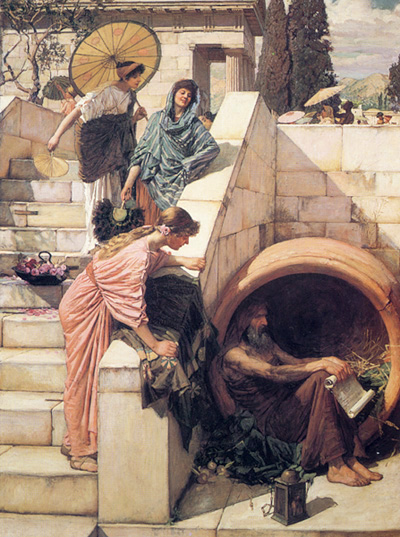
"The nude Cynic fears no fire for his tub; if broken, he will make himself a new house to-morrow, or keep it repaired with clamps of lead."
Juvenal, Satires (XIV.308ff)
Diogenes of Sinope (fourth century BC) is too irascible a character not to share some anecdotes about him from the compendium of Diogenes Laertius on the Lives of the Eminent Philosophers. They illustrate the precepts by which he lived: that personal happiness is satisfied by meeting one's natural needs and that what is natural cannot be shameful or indecent. His life, therefore, was lived with extreme simplicity, inured to want, and without shame. It was this determination to follow his own dictates and not adhere to the conventions of society that he was given the epithet "dog," from which the name "cynic" is derived. (As to why he was called a dog, Diogenes replied, "Because I fawn upon those who give me anything, and bark at those who give me nothing, and bite the rogues.") Sold as a slave, he pointed and said, "Sell me to this man; he needs a master." The man heeded the advice, and entrusted Diogenes with his household and the education of his children.
Seeing a child drinking from his hands, Diogenes threw away his cup and remarked, "A child has beaten me in plainness of living." When invited to the house of Plato, he trampled upon his carpet, saying that he thereby trampled on the vanity of Plato, to which Plato retorted "How much pride you expose to view, Diogenes, by seeming not to be proud." To Plato's definition of a man as an animal, bipedal and featherless, Diogenes plucked a chicken and declared, "Here is Plato's man."
Alexander the Great was reported to have said, "Had I not been Alexander, I should have liked to be Diogenes." Once, while Diogenes was sunning himself, Alexander came up to him and offered to grant him any request. "Stand out of my light," he replied. (There are many other references to this incident, principally Plutarch, Life of Alexander, XIV.1–5.) When asked why he went about with a lamp in broad daylight, Diogenes confessed, "I am looking for a [honest] man." Seeing a young man blush, he remarked that it was the complexion of virtue.
Why do people give to beggars, he was asked, but not to philosophers? "Because they think they may one day be lame or blind, but never expect that they will turn to philosophy." To a young man who complained that he was ill suited to study philosophy, Diogenes said "Why then do you live, if you do not care to live well?" Of grammarians, he was astonished that they desire to learn everything about the misfortunes of Odysseus but nothing about their own. Of mathematicians, that they keep their eyes on the heavens and overlook what is at their feet. Of orators, that they speak of justice but never practice it. When asked why he alone praised an indifferent harp player, Diogenes replied "because he plays the harp and does not steal."
When asked what wine he found most pleasant to drink, Diogenes replied, "That for which other people pay." Once, eating some dried figs, he offered some to Plato, which prompted Diogenes to remonstrate "I said that you might have a share of them, not that you might eat them all." As to when was the proper time to eat, he replied that for the rich, whenever one pleases; for the poor, whenever one can. Asked why he begged in front of a statue, Diogenes replied that he did so to get used to being refused. Reproached for behaving indecently in public, he lamented only that he wished it were as easy to relieve hunger by rubbing one's stomach. And criticized for drinking in a tavern, he said that he also had his hair cut in a barber's shop.
Of the golden statue of Phrynê at Delphi, Diogenes was said to have written upon it: "From the licentiousness of Greece." And, when he saw the child of a courtesan, whom he compared to a "deadly honeyed potion," throwing stones at a crowd, he cried out: "Take care you don't hit your father." Seeing a bad archer, he sat down beside the target so get out of harm's way. When asked when a man should marry, he replied that a young man ought not to marry just yet and an old man not at all. Asked why he anointed his feet with scent, he replied that he then would be able to smell it; if on his head, it only would pass into the air above him.
Chided as an old man who ought to rest, he replied, "What, if I were running in the stadium, ought I to slacken my pace when approaching the goal?" To someone who declared life to be an evil, he corrected him, "Not life itself, but living ill." When asked from where he came, Diogenes said, "I am a citizen of the world" (cosmopolitan), and, when someone was queried as to what sort of man Diogenes was, the reply was given, "A Socrates gone mad."
In the detail above from Diogenes (1882) by John William Waterhouse, the artist dutifully shows the lamp and the broken tub (and the diet of onions). The shadow is cast by a young woman, who substitutes for Alexander standing between the sulking Diogenes and the sun. She has been painted to resemble the terracotta figurines from Tanagra in Boeotia that had been discovered just a dozen years earlier.
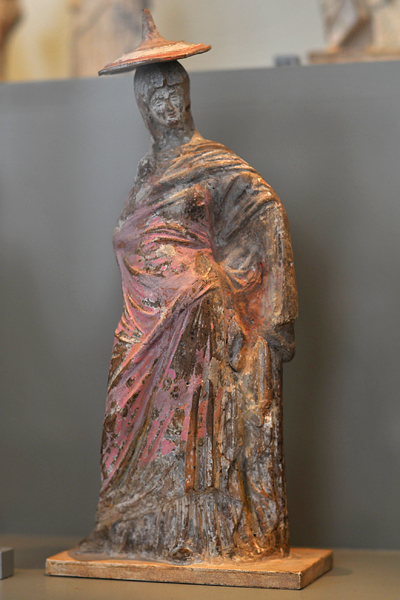
This example is in the Altes Museum (Berlin). The pull of the drapery over the body, traces of color, and the individual expressions and casual poses all created a sensation at the time. By 1873 (when the Archaeological Society of Athens began to take responsibility for excavations), the molded figurines, which were produced from about 350 BC and originally developed in Athens, had flooded the market, prompting both heavily restored and completely forged pieces.
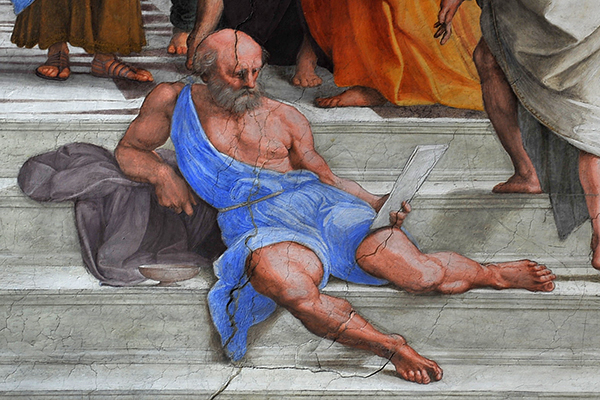
Just as Waterhouse positions the philosopher next to a staircase, so Raphael places him on the stairs below the feet of Aristotle in the The School of Athens (1509-1511), a fresco that decorated one of the papal apartments of Julius II in the Vatican. Fittingly, a shadow is cast over the isolated figure.
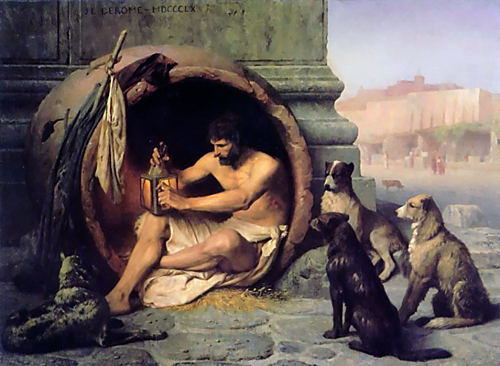
If the symbolism of Waterhouse's painting is too subtle, the Diogenes (1860) of Jean-Léon Gérôme is not.
In his Lives of the Eminent Philosophers, Diogenes Laertius also writes about Epicurus (341–270 BC), who proposed that the purpose of philosophy was to secure a happy life: "I know not how to conceive the good, apart from the pleasures of taste, sexual pleasures, the pleasures of sound and the pleasures of beautiful form." His mistress was the hetaira Leontion.
Like Diogenes, Socrates, too, was said to have been, not Athenian or Greek, but a citizen of the world (Plutarch, On Exile, 5F)—as, of course, was Rick in Casablanca.
References: Diogenes Laertius: Lives of the Eminent Philosophers (1925) translated by R. D. Hicks (Loeb Classical Library); J. W. Waterhouse (2002) by Peter Trippi.
