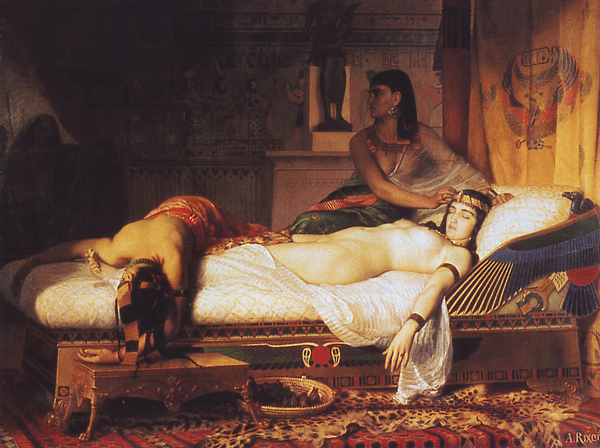
"Cleopatra sent to Caesar a letter which she had written and sealed; and, putting everybody out of the monument but her two women, she shut the doors. Caesar, opening her letter, and finding pathetic prayers and entreaties that she might be buried in the same tomb with Antony, soon guessed what was doing. At first he was going himself in all haste, but, changing his mind, he sent others to see. The thing had been quickly done. The messengers came at full speed, and found the guards apprehensive of nothing; but on opening the doors, they saw her stone-dead, lying upon a bed of gold, set out in all her royal ornaments. Iras, one of her women, lay dying at her feet, and Charmion, just ready to fall, scarce able to hold up her head, was adjusting her mistress's diadem. And when one that came in said angrily, 'Was this well done of your lady, Charmion?' 'Extremely well,' she answered, 'and as became the descendant of so many kings'; and as she said this, she fell down dead by the bedside."
Plutarch, Life of Antony (LXXXV.2-3, Dryden trans.)
Cassius Dio relates that, after the naval defeat at Actium (31 BC), Cleopatra hurriedly returned to Egypt to forestall any revolt at home. Once there, she killed those who had rejoiced at her disaster and "proceeded to gather vast wealth from their estates and from various other sources both profane and sacred, sparing not even the most holy shrines" (Roman History, LI.5.5ff). Her son Caesarion, together with a portion of the royal treasury, were sent up the Nile with the intention that he cross overland by way of Ethiopia and sail on to India. But he was overtaken and executed (LI.15.5; Cleopatra, herself, was to have followed but her ships were burned at the instigation of the Romans). To gain time, emissaries also were sent Caesar with entreaties that her children be allowed to succeed to the throne. Antony himself professed that he was willing to retire to private life or even prepared to kill himself if it would save the queen. The accompanying bribes were retained but the replies evasive. (The lives of Cleopatra's three children by Antony were spared, however; and Cleopatra Selene was allowed to marry the son of Juba, king of Numidia.)
Even so, Octavian was concerned that they both "might destroy their wealth, which he kept hearing was of vast extent; for Cleopatra had collected it all in her tomb which she was constructing in the royal grounds, and she threatened to burn it all up with her in case she should fail of even the slightest of her demands" (LI.8.5-6). Without this treasure, his soldiers could not be paid. Privately, therefore, he intimated to Cleopatra of pardon and even of love, so that "by this means at least...she would make away with Antony and keep herself and her money unharmed" (LI.8.7).
On August 1, 30 BC, Antony confronted Octavian, but his fleet and cavalry surrendered without a fight, and the infantry was defeated. Cleopatra fled to her mausoleum and sealed herself and her treasure inside, accompanied only by her maidservants Iras and Charmion (and, says Dio, a eunuch). A message then was sent to Antony that she had committed suicide, perhaps to prompt him to do the same (and so curry favor with Octavian). This he did, but the wound was not immediately fatal and, hearing that Cleopatra still was alive, he was taken to her, being hoisted through an upper-story window and dying there in her chamber on August 10.
Soon, Octavian sent a member of his staff to the queen, "bidding him, if possible, above all things to get Cleopatra into his power alive; for he was fearful about the treasures in her funeral pyre, and he thought it would add greatly to the glory of his triumph if she were led in the procession" (Plutarch, Life of Antony, LXXVIII.3; also Dio, LI.11.3). By a ruse, Cleopatra was taken but, dispirited at the death of Antony and her own capture, fell ill (says Plutarch) and was moved to the palace.
Octavian now confronted a dilemma. Although said to have wanted to parade Cleopatra in his triumph (Dio, LI.13.1; Plutarch, LXXVIII.3), he may have remembered that the appearance of her younger half-sister Arsinoë in chains at the triumph of Caesar had "aroused very great pity" (Dio, XLIII.19). Too, such a display might not reflect well on Caesar, himself, who had placed a golden statue of Cleopatra in the Temple of Venus Genetrix (Dio, LI.22.3; Appian, II.102). But she could not be allowed to live or Octavian be seen as responsible for her death. Some dissembling, therefore, must have taken place on both sides: Octavian inviting Cleopatra to return to Rome and Cleopatra pretending that she would go (cf. Dio, LI.13). Instead, she may have been given an opportunity simply to die by her own hand, and this she did on August 12, aged thirty-nine years, wearing her most beautiful garments, her body arrayed on a golden couch and the emblems of royalty in her hands.
Although Cleopatra poisoned herself, no-one quite knew how. Plutarch relates that there were two slight pricks on her arm and that poison might have been hidden in a hollow comb (knestis), a word used rarely enough to suggest that he may have adhered to an earlier account (LXXXVI.2-3). Dio comments upon the marks as well, which may have been caused by a poisonous pin used to fasten her hair (LI.14.1). Or they may have been from the bite of an asp, which must have been hidden in a basket of flowers (or figs) or a water jar, although no snake ever was found. If snakes and figs, the imagery may have been deliberately calculated, given their sexual connotations and the desire to portray Cleopatra as a foreign seductress.
Certainly, Octavian favored the notion that Cleopatra died from a snake bite, which is how she was depicted in his triumphal procession, with an asp clinging to her image (Plutarch, LXXXVI.3; cf. Dio, LI.21.8, "an effigy of the dead Cleopatra upon a couch was carried by, so that in a way she, too,...was a part of the spectacle and a trophy in the procession"). It also is the version adhered to by the Augustan poets, who wrote within a decade after Actium. In the Aeneid, Virgil speaks of the queen not turning her head "to see twin snakes of death behind" (VIII.696-697). Horace (Odes, I.37, "Nunc est bibendum") and Propertius (Elegies, III.11.53-54) also speak of two snakes (presumably one for the queen and the other for her servants), not one, although the other primary source, Velleius Paterculus, does mention a single asp (II.87). Martial, too, associates a viper with Cleopatra (Epigrams, IV.59).
Whether a rhetorical flourish, the manner of Cleopatra's death was an exotic one, befitting a queen of Egypt. If by the bite of a cobra, it would have been even more symbolic, as the snake was emblematic of the uraeus, the stylized image that the queen would have worn on her pharaonic headdress, and sacred to the goddess Isis, of whom she felt herself to be the incarnation—the "New Isis" (Plutarch, Life of Antony, LIV.6). It would have been ironic as well that the cobra, symbolic of the intention to protect the queen, would have been the means of her death.
The Greeks do posit an alternative explanation. Strabo is the earliest source for Cleopatra's suicide and even may have been in Alexandria at the time she died. (Plutarch wrote more than a century after the events he describes, Dio, a century later still, although his source probably was a history by Olympus, Cleopatra's personal physician, whom he mentions, LXXXII.2; also Plutarch, LXXXII.2.). He is of two minds: whether it was "by the bite of an asp or (for two accounts are given) by applying a poisonous ointment" (XVII.10). Galen, writing in the second century, says in De Theriaca ad Pisonem (CCXXXVII) that she broke the skin by deeply biting her own arm and then applied poison to the wound. And, to be sure, poison does seem to be a more probable cause of Cleopatra's death than the uncertainty of a serpent's tooth—especially since, as Plutarch declared, "The thing had been quickly done" and the messengers who "came at full speed" in response to the queen's letter arrived too late to save her.
Roman authors, however, continued to insist otherwise. Suetonius, a contemporary of Plutarch, indicates in his Life of Augustus that she died from the bite of an asp, the poison of which Octavian had tried to have sucked from the wound by the Psylli, snake charmers from North Africa famous for that ability (XVII.4). Florus, a younger contemporary, has Cleopatra, dressed in her finest raiment, apply two serpents (II.21.11). Shakespeare, too, has her being bitten by two snakes: "Here on her breast there is a vent of blood, and something blown [swollen]; The like is on her arm" (Antony and Cleopatra, V.ii).
Whether Cleopatra was bitten by a snake (and, if so, where and by how many) or poisoned herself, "The truth of the matter no one knows" (Plutarch, LXXXVI.2).

A student of the Ecole des Beaux-Arts in Paris and second-place winner of the Prix de Rome, Alexandre Cabanel (1823-1889) was among the most successful academic painters of the later nineteenth century, known both for his lush renderings of the female nude, such as The Birth of Venus (1863), as well as classical subjects such as Cleopatra Testing Poisons on Condemned Prisoners (1887) above. Dio relates, in his discussion of Cleopatra's preparation for her suicide, that "she kept at hand fire to consume her wealth, and asps and other reptiles to destroy herself, and she had the latter tried on human beings, to see in what way they killed in each case" (LI.11.2). Plutarch, too, speaks of Cleopatra fascination with poisons, witnessing herself which venomous creature was most efficacious. "She did this daily, tried them almost all; and she found that the bite of the asp alone induced a sleepy torpor and sinking, where there was no spasm or groan, but a gentle perspiration on the face, while the perceptive faculties were easily relaxed and dimmed, and resisted all attempts to rouse and restore them, as is the case with those who are soundly asleep" (Life of Antony, LXXI.5).
Cleopatra also played on Antony's fear of being poisoned, who refused to take any food that had not been tasted. Laying a garland of poisoned flowers on his head, she suggested, as the revelry grew wilder, that they all drink their chaplets. As Antony was about to drink from the cup into which he had scattered his flowers, she stopped him. A prisoner was brought in and commanded to drink, dying on the spot (Pliny, XXI.7.9).
It was during the siege of Alexandria, during which "many places were set on fire, with the result that the docks and the storehouses of grain among other buildings were burned, and also the library, whose volumes, it is said, were of the greatest number and excellence" (Dio, XLII.38.2), that Arsinoë was surrendered to Caesar (Civil Wars, III.112, Alexandrine War, XXXIII). Transported to Rome, she was paraded in triumph in 46 BC, after which she was exiled to Ephesus, where she was given sanctuary in the Temple of Artemis. There, at the instigation of Cleopatra, she was slain by Antony (Josephus, Antiquites of the Jews, XV.4.1).
Appian (Civil Wars, V.9) mistakenly has Arsinoë at the Temple of Artemis in Miletus, where she is killed by assassins sent by Antony, who then ordered the priest of the temple at Ephesus to be brought before him, presumably for his dereliction in having failed to protect the suppliant. In Dio (XLVIII.24.2), it is Cleopatra's brothers who are killed.
The Death of Cleopatra (1874) by Jean André Rixens is in the Musée des Augustins (Toulouse). Cleopatra Testing Poisons on Condemned Prisoners (1887) is in the Royal Museum of Fine Arts (Antwerp).
References: Dio Cassius: Roman History (1914-) translated by Earnest Cary and Herbert B. Foster (Loeb Classical Library); Plutarch: Parallel Lives (1916-) translated by Bernadotte Perrin (Loeb Classical Library); Appian: Roman History, The Civil Wars (1913) translated by Horace White (Loeb Classical Library); Strabo: Geography (1917-) translated by H. L. Jones (Loeb Classical Library); Propertius: Elegies (1990) translated by G. P. Goold (Loeb Classical Library); Velleius Paterculus: Compendium of Roman History (1924) translated by Frederick W. Shipley (Loeb Classical Library); Virgil: The Aeneid (1981) translated by Robert Fitzgerald; Florus: Epitome of Roman History (1929) translated by Edward Seymour Forster (Loeb Classical Library); Cleopatra (1972) by Michael Grant; "Vergil, The Augustans, and the Invention of Cleopatra's Suicide: One Asp or Two?" (1998) by Adrian Tronson, in Vergilius, 44, 31-50; Cleopatra (2006) by Susan Walker and Sally-Ann Ashton.
See also The Great Library of Alexandria.
