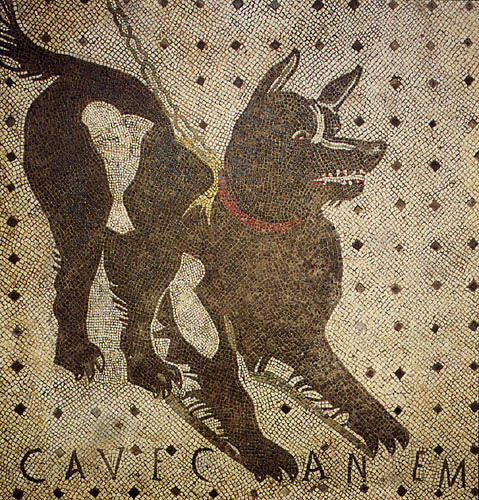
"There on the left as one entered...was a huge dog with a chain round its neck. It was painted on the wall and over it, in big capitals, was written: Beware of the Dog."
Petronius, Satyricon (XXIX)
Of the canine breeds mentioned by classical authors, the best known were the swift Laconian (Spartan) and the powerful Molossian, both of which were native to Greece and used by the Romans for hunting (canis venaticus) and to watch over the house and livestock (canis pastoralis). "Never, with them on guard," says Virgil, "need you fear for your stalls a midnight thief, or onslaught of wolves, or Iberian brigands at your back" (Georgics, III.404ff). It is the tawny Spartan and the Molossian, says Horace, who are "the shepherd's dangerous friends" (Epodes, VI).
Cato is the first Roman to write about agriculture, although, as the earliest example of Latin prose, De Agri Cultura (c. 160 BC) is little more than a miscellaneous collection of precepts on husbandry and farming. He says simply that "Dogs should be chained up during the day, so that they may be keener and more watchful at night" (CXXIV). Varro agrees. In De Re Rustica, written when he was eighty-years old (c. 37 BC) and addressed to his wife, who had just purchased a farm, he advises that a few active dogs of good traits should be kept, trained to sleep indoors during the day and keep watch at night (I.21). "They must be kept as a matter of course, for no farm is safe without them" (I.19.3). Two sorts of dogs are recognized: "the hunting-dog suited to chase the beasts of the forest, and the other which is procured as a watch-dog and is of importance to the shepherd" (II.9.2).
Varro speaks only of the second type, "the guardian of the flock, which needs such a champion to defend it." It should have a large head, drooping ears, thick shoulders and neck, wide paws, thick tail, a deep bark, and be white in color so as to be more easily recognized in the dark. Care should be taken that it is a good breed, a Spartan for example, and that the dog be purchased from a shepherd rather than a hunter to ensure that it has been trained to follow sheep rather than chase after a hare or stag (II.9.5). A nail-studded leather collar (melium) should be fitted to protect the neck. Once wounded, a wolf also will be less likely to attack another dog, even one not wearing a collar (II.9.15).
Almost a hundred years later, Columella provides a more systematic treatment of the subject in his own agricultural manual De Re Rustica, which deals with the farm-yard and sheep dog but not the hunting dog, which "not only does not help the farmer but actually lures him away from his work, and makes him lazy about it" (VII.11.2). Indeed, buying a dog should be "among the first things which a farmer does, because it is the guardian of the farm, its produce, the household and the cattle" (VII.11.1). It should be big and have a loud bark, first to intimidate the intruder when it is heard and then when it is seen. Color too is important. An all-white dog is recommended for the shepherd to avoid mistaking it for a wolf in the half-light of dawn or dusk, and an all-black guard dog for the farm to terrify thieves in the daytime and be less visible to trespassers at night. It should not be too savage, so as not to attack the inhabitants of the house, nor so mild that it fawns over the thief. The farm-yard dog should be heavily built, with a large head, drooping ears, bright eyes, a broad and shaggy chest, wide shoulders, thick legs, and short tail. Because it is expected to stay close to the house and granary, a lack of speed is not important. The sheep dog, on the other hand, should be long and slim, strong and fast enough to repel a wolf or pursue one that has taken its prey. (In the Digest of Justinian [XLI.1.44], an example is given in which pigs carried off by wolves were recovered by dogs from a neighboring farm. The question then was to whom the animals belonged—in this case, the original owner.)
If the agricultural manuals neglect the hunting dog, it is the subject of another literary genre, a work on hunting with dogs or Cynegeticon. The earliest and most informative of these treatises is attributed to Xenophon, who was born about 430 BC and better known as the author of the Anabasis and Hellenica. He describes two varieties of Laconian hounds, the Castorian, named after Castor, who was said to have taken a special interest in them, and the Vulpine, which were thought to be the offspring of a dog and a fox. The Laconian should be large, with a small head, straight nose, upright ears, a long and supple neck, and eyes that are black and sparkling. It should either be tan with white markings on the face, chest, legs, and rear; or black with tan markings (Cynegeticus, IV.1, 7–8). A hound that tracked by scent, the Laconian should "give chase vigorously without relaxing, with much clamor and baying, all coming out together after the hare on every side. Let them pursue fast and brilliantly, borne along after her in a pack, giving tongue properly again and again" (IV.5). Driven by the pursuing hounds, the prey then is trapped in nets strung across its path.
"If you are not bent on looks and deceptive graces," writes the Augustan poet Grattius in about AD 8, and "when serious work has come, when bravery must be shown, and the impetuous War-god calls in the utmost hazard, then you could not admire the renowned Molossians so much" (Cynegeticon, 179ff). The Molossian, a heavy mastiff used by the shepherds of Epirus in the mountains of northwestern Greece, protected the flock and guarded the house. In the Satyricon, Trimalchio has an enormous Molossian named Scylax (Pup), brought in on a chain and introduced to his guests as guardian of the house and slaves. (The Laconians are the dogs that cause such a din outside the dining room in the Satyricon of Petronius and then burst in, dashing around the table.)
The Molossian also participated in the spectacle of the animal hunt. Marital, in De Spectaculis, a series of poems commemorating the opening of the Colosseum by Titus in AD 80, describes the sight of a deer in the amphitheater being chased by Molossians. Stopping in front of the emperor's podium, it was left untouched by the hounds (XXX). The poet also is the first to speak of the Vertragus, an ancestor of the modern greyhound, who "hunts not for himself but for his master, and will bring you the hare unhurt in his teeth" (Epigrams, XIV.200). Grattius contends that "great glory exalts the far-distant Celtic dogs," also referring to the yellow-spotted Vertragus. "Swifter than thought or a winged bird it runs, pressing hard on the beasts it has found" (204ff).
Arrian has much to say about the breed in the Cynegeticus, written in Greek about AD 150 as a supplement to the manual of Xenophon, after whom he styles himself. He suggests that Xenophon must not have known of the Vetragus, which was named for its swiftness; otherwise, he never would have written that the hound could not catch a hare except by luck. If the Vertragus does not run down the hare, he argues, it must be because of broken ground or a concealing thicket or ditch. A hare startled too close will not even have a chance to run at all. "Splendid animals, the best bred of them, with fine eyes, fine bodies all over, fine coats, and fine appearance" (III.7), they should be long from head to tail, with a sturdy build, a muzzle that comes to a point, and large soft ears. The eyes should be prominent, large and bright and "should astonish the man who sees them" (IV.5). Again, he corrects Xenophon: "The color makes no difference, whatever it may be, not even if hounds are black or tan or white all over" (VI.1).
Chasing the hare by sight rather than by scent (a sight-hound rather than a scent-hound), the Vertragus revolutionized the hunt or venatio. The Laconian hounds known to Xenophon were slow and tracked by smell alone and, if the trail was uncertain, the prey frequently escaped, which is why Xenophon describes other equipment, such as nets and snares. With the Vertragus, however, the hunter was able to follow the chase on horseback, rather than running behind on foot. So swift was the dog that it also was used in coursing, a sport introduced by the Celts sometime before the second century AD, the purpose of which was not to hunt the hare at all but simply to enjoy the sport of the chase, seeing whose animal was best. "For one does not take hounds out in order to catch the beast," says Arrian, "but for a race and competition, at least if one is a true sportsman."
Cynegetica, a poem in Greek ascribed to Oppian and dedicated to Caracalla sometime after AD 212, recommends the Laconian "for the swift chase of gazelle and deer and swift-footed hare" (I.412ff). He also describes the Molossian. "Impetuous and of steadfast valour, who attack even bearded bulls and rush upon monstrous boars and destroy them....They are not swift, but they have abundant spirit and genuine strength unspeakable and dauntless courage" (414ff). For the hunter, black and white dogs of the farmer and shepherd are not desirable. "Among all dogs those are the best whose colour is like that of ravenous wild beasts, sheep-slaying wolves or wind-swift tigers or foxes and swift leopards, or those which have the colour of Demeter's yellow corn; for these are very swift and strong" (430ff). Nor should they bark, "for silence is the rule for hunters and above all for trackers" (449ff).
Hounds from Celtic Britain were famous, as well, and exported to Rome even before the conquest. (Writing at the beginning of the first century BC, the Greek geographer Strabo mentions dogs "that are by nature suited to the purposes of the chase," Geography, IV.5.2) "It is not only Spartan whelps or only Molossian which you must rear," says the poet Nemesianus in Cynegetica (c. AD 283), "sundered Britain sends us a swift sort, adapted to hunting-tasks in our world" (224ff). One imagines them chasing rabbits or deer on the Celtic Castor ware of Britain from the second century AD. About AD 400, Claudian, the last poet of classical Rome, speaks of "deathless Molossian hounds run barking about the chariot amid the clouds...splendid Spartans, and Britons that can break the backs of mighty bulls" (On Stilicho's Consulship, III.294ff; also II.215), which may have been Irish wolfhounds or Scottish deerhounds.
As Arrian said of Horme (Impulse), his own gray-eyed Vertragus, so for all who have had such a companion: she was "most swift and wise and divine" (V.6).
Speed was an essential quality of a hunting dog, for which the most common epithet in Homer is Argos ("swift-footed"), the name of Odysseus' own hound. Indeed, Argos is the only dog in Homer to have a name (XVII.319ff). Trained as a puppy to chase after wild goats, deer, and hares, no quarry ever escaped him. This faithful dog, unable to move and thumping only his tail, dies at the shock of recognizing his master, returning home after twenty years. Aelian does not accept the age of the dog, saying that the longest life of a dog is fourteen years and calling the story about Argos "a playful tale of Homer's" (On Animals, IV.40), although Aristotle contends that some breeds did live to twenty (History of Animals, VI.20). Odysseus praises Argos for his speed and strength and beautiful appearance, but the breed is not mentioned. Given that Argos chased after less ferocious game, such as deer and hare, and emphasis is made of his swiftness, he very well may have been a Laconian. Another dog whose breed is not known but whose name is mentioned in antiquity is Peritas, reared by Alexander the Great.
The dogs of Eumaeus, Odysseus' loyal swineherd, likely were Molossians. "Like savage beasts," they do not recognize the stranger and rush snarling at Odysseus, barking furiously. "A moment more, my pack would have torn you limb from limb," warns Eumaeus (IV.23, 41), although a familiar figure is not a threat. When Telemachus, the son of Odysseus, goes up to them later, "the howling dogs went nuzzling up around him, not a growl as he approached" (XVI.5). And when Athena reveals herself to the hero, only Odysseus sees her—and the dogs, who, conscious of the divine, run away, whimpering and cringing (XVI.183).
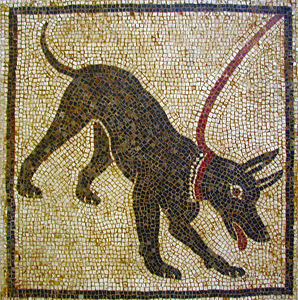
Horace envisions himself as a sheep-dog, who will "prick my ears up and will chase chase through deepest snow whatever beast will run from me" (Epodes, VI). That he is not comparing himself to a hunting dog can be seen in the admonition of Xenophon, who remarks that dogs cannot follow the track of a hare in falling or blowing snow (VIII.1ff). Arrian, too, cautions against letting hounds course in cold weather (XIV.5; cf. Oppian, who says that, although the hunter may follow a track marked in the snow, dogs trace by scent, I.455ff). The sheep-dog, on the other hand, has no choice but to pursue the wolf in winter, for that is when the predator is most hungry. (This guard dog, neatly framed, is in the National Archaeological Museum, Naples.)
Although Homer and other ancient authors tended to classify dogs according their function, such as hunting or guarding the herd or estate, individual breeds eventually came to be recognized. Four groups of dogs usually are discerned from Greek representations and descriptions: the Laconian and Molossian; the Cretan, a Laconian probably crossed with the Molossian; and the Melitan from Malta, a small long-haired, short-legged lap dog. The working dogs discussed in Varro and Columella probably were cross-breeds as well.
When asked what sort of dog he was, Diogenes the Cynic replied that, when hungry, a Melitan; when satisfied, a Molossian, a dog that tended to be praised by those who did have to hunt with them because of the difficulty in keeping up (Diogenes Laertius, Lives of Eminent Philosophers, V).
Finally, Synesius of Cyrene, bishop and correspondent with Hypatia, complains in a letter to her that "my Cynegetics disappeared from my house, how I know not" (Ep.154).
The mosaic of a guard dog (top), one of several in Pompeii, is on the floor of the entrance hall to the House of the Tragic Poet, which also is known for its fresco of the Sacrifice of Iphigenia.
References: Hounds and Hunting in Ancient Greece (1964) by Denison Bingham Hull (which includes a translation of Arrian and selections from the Onomasticon by Julius Pollux, both of which are not in the Loeb Classical Library); Animals in Roman Life and Art (1973) by J. M. C. Toynbee; Animals in Greek Sculpture (1930) by Gisela M. A. Richter; Dogs in Antiquity (2001) by Douglas Brewer, Terence Clark, and Adrian Phillips; Hunting in the Ancient World (1985) by J. K. Anderson; Arrian of Nicomedia (1980) by Philip A. Stadter; The Hunt in Ancient Greece (2001) by Judith M. Barringer; "Dogs in Ancient Greek Poetry" (1976) by Saara Lilja, Commentationes Humanarum Litterarum, No. 56; De Canibus: Dog and Hound in Antiquity (1971) by R. H. A. Merlen..
Xenophon and Arrian: On Hunting (1999) translated by A. A. Phillips and M. M. Willcock (with commentary); Xenophon: Scripta Minora (1968) translated by E. C. Marchant (Loeb Classical Library); Columella: On Agriculture (1941) translated by Harrison Boyd Ash (Loeb Classical Library); Minor Latin Poets [Grattius] (1935) translated by J. Wight Duff and Arnold M. Duff (Loeb Classical Library); Marcus Porcius Cato: On Agriculture and Marcus Terentius Varro: On Agriculture (1935) translated by William Davis Hooper, revised by Harrison Boyd Ash (Loeb Classical Library); Strabo: Geography (1923) translated by Horace L. Jones (Loeb Classical Library); Martial: Epigrams (1968) translated by Walter C. A. Ker (Loeb Classical Library); Oppian, Colluthus and Tryphiodorus (1928) translated by A. W. Mair (Loeb Classical Library); Claudian [On Stilicho's Consulship] (1922) translated by M. Platnauer (Loeb Classical Library); Horace: The Complete Odes and Epodes (1997) translated by David West (Oxford World's Classics); Lucan: Civil War (1992) translated by Susan H. Braund (Oxford World Classics); Homer: The Odyssey (1996) translated by Robert Fagles.
